May 2016
24
I
ndustrial
C
omputing
Energy-efficient architectures:
economical, yet powerful
By Konrad Zöpf,
TQ Group
With modern ARM processor
architectures, such as Cortex-A7,
Cortex-A8 and A9, many functions
are already integrated into the CPU.
This way, cost-optimized systems can
be generated in a simple manner.
We are being required more and more to
save energy, whether it is in the household
using LED bulbs and energy-efficient appli-
ances or in the automotive industry with elec-
tric drive units. In order to be able to develop
devices that handle resources economically,
the manufacturers of semiconductors are
required to pay attention to energy efficiency
with the development of electronic compo-
nents. New standards have particularly been
set in the area of CPU manufacturing in
recent years. The aim is to reduce the power
loss, save costs and increase the process-
ing performance. Through the use of newly
developed technologies, such as high speed
and data throughput at low clock frequencies
and low power loss, the future challenges for
CPUs can be managed.
All chip manufacturers of various process
architectures are working on these technol-
ogies and are virtually competing with one
another to secure themselves market shares
with their products: Intel focuses on the
graphics performance in order to control
several 4K displays. With the ARM CPUs,
the focus is more on the peripheral units, so
that barely any additional building blocks are
required to realize a system. It is assumed that
Intel will develop additional processors in the
next few years on the basis of new technolo-
gies, in order to compete with ARM and oth-
ers with competitive products. Conversely, it
can also be observed that manufacturers that
develop ARM-based CPUs are moving in the
direction of the Intel performance class, in
order to stand up to the competition and not
lose any market shares to Intel.
Even if the two typical embedded architec-
tures - ARM and Power Architecture - are
still not able to keep up with the processing
performance and integrated graphics per-
formance of Intel, they are not only scoring
points regarding the expanded temperature
range and the very low maintained power loss.
On the basis of chip surface, they offer signifi-
cantly higher integration of the functionality
and available interfaces in a single-chip solu-
tion.
ARM even has the highest performance per
chip surface compared to the other archi-
tectures and is a leader in chip technology.
Rapid further development is presently being
observed with the ARM CPUs of several man-
ufacturers: in respect of efficiency, in addition
to the current processor cores with 32-bit
architecture, such as Cortex-A7, Cortex-A8
and Cortex-A9, ARM will soon be offering
processor cores that are based on a 64-bit
architecture, such as Cortex-A53 or Cor-
tex-A72. In spite of the increasing efficiency,
they can continue to show a very good ratio
between processing performance and power
loss.
This advantage is being used by the ARM chip
manufacturers and they are integrating the
appropriate application-specific interfaces for
virtually every market. A price-optimized and
function-optimized derivative on the basis of
various ARM processor cores is available for
all industries, whether it is for the automotive
industry, networking (figure 1), automation
or control and regulation technology. In addi-
tion to this, it appears that enhanced power
management functions are being integrated,
in order to meet the market requirements
even better with regard to saving energy.
With ARM CPUs of various manufacturers,
many interfaces have already been integrated
into the CPU, such as graphics, Ethernet,
CAN, A/D converters, SPI and digital I/Os.
This means that due to the versatility of the
interfaces, most of the system requirements
can be implemented without major addi-
tional effort. Through the variety of interfaces
and the free selection of an operating system,
the ARM processors are universally imple-
mentable. Driven by the good application
support of the CPUmanufacturers for various
market segments, more and more devices are
being developed on the basis of this architec-
ture.
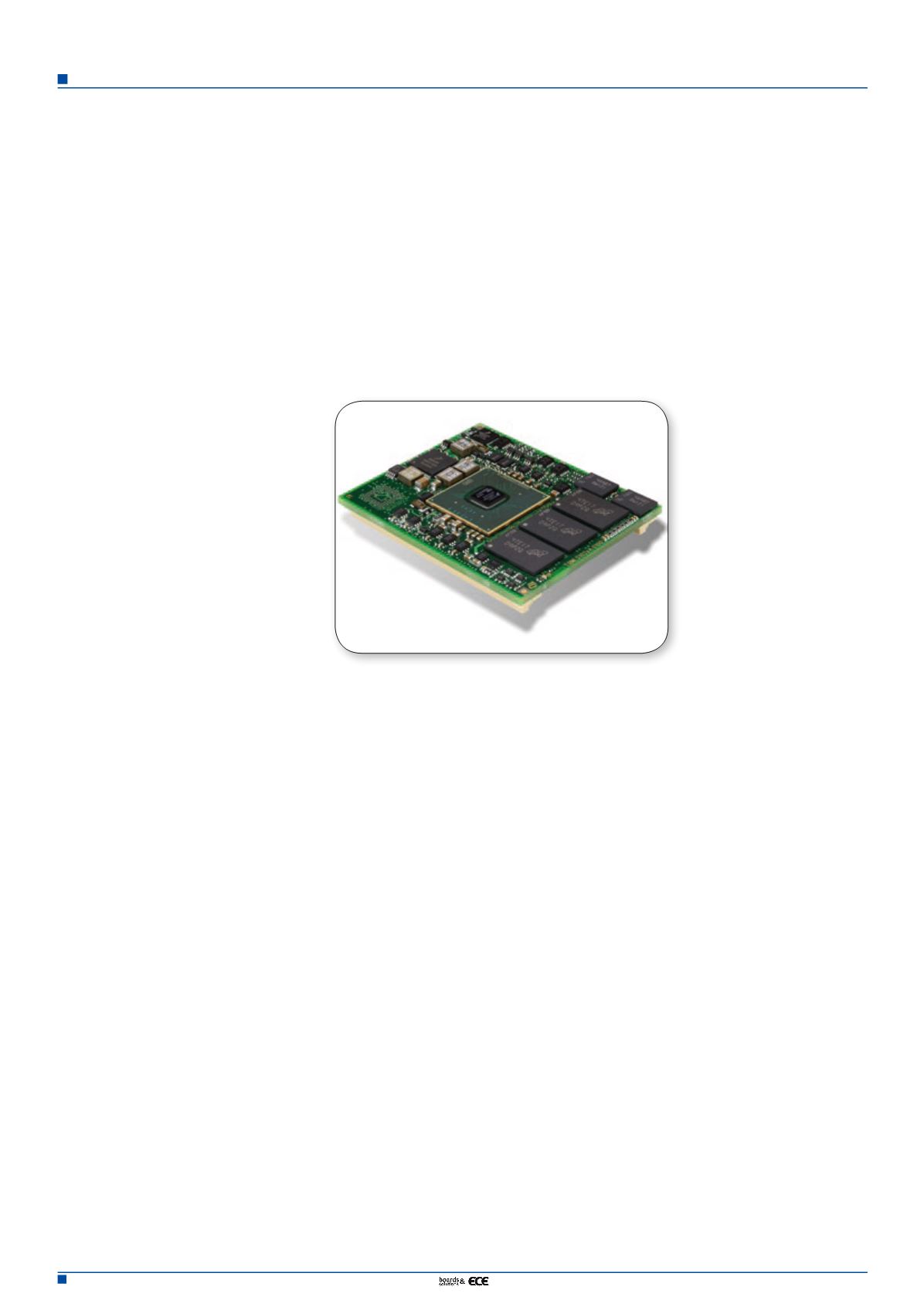
Figure 1. The TQMLS102xA
module combines the ARM
architecture in the form of the
LS102xA Freescale processor,
with the QorIQ communicati-
on technology. The integrated
graphics controller supports
applications with a display and
touch screen.


