May 2016
20
I
ndustrial
C
omputing
MicroTCA for highly sophisticated
embedded computing applications
By Rüdiger Cölln,
Pentair
Besides high computing power,
systems for high performance
applications like data acquisition or
imaging processing require high-grade
availability and easy manageability.
To provide these a commercial
off-the-shelf system (COTS) is needed.
MicroTCA meets these requirements
while keeping the cost down and
offering the best solution for highly
sophisticated applications.
Designers of embedded systems face two
significant challenges. While performance
and system stability requirements are con-
stantly increasing, they have to deal with
commercial limitations in parallel. Existing
platforms like Industrial PCs, COM Systems
or eNUC solutions are designed to deliver a
certain computing power while keeping the
product cost low. These systems, however, are
definitely not the right choice for high per-
formance applications such as data acquisi-
tion or image processing. In addition to high
computing power, such applications require
a high grade of availability and easy manage-
ability. To cover these technical and commer-
cial requirements a commercial off-the-shelf
(COTS) system is needed.
COTS systems offer many of benefits to their
users. MicroTCA is one PICMG standard and
describes a modular standard for building
high performance switched fabric computer
systems in a small form factor. It has its ori-
gin from the open standard AdvancedTCA
which was initially developed for telecom
applications. MicroTCA preserves many of
the important philosophies of AdvancedTCA,
including basic interconnect topologies for
high speed data transfer and the management
structure to ensure a high grade of availability.
Using open standards enables an application
designer to concentrate their development on
the application-specific part of their product.
They don’t need to worry about the infrastruc-
ture or environment of the system since this
is already defined by the open standard spec-
ification.
The core specification, MTCA.0, defines the
basic system, including backplane, card cage,
cooling, power, and management. A variety of
different sized AMC modules are supported,
allowing the system designer to use as much
or as little computing and I/O as necessary. By
configuring highly diverse collections of pro-
cessing and I/O AMCs in a MicroTCA shelf,
many different application architectures can
be easily realized. Because of its modularity
and flexibility, the MicroTCA standard pro-
vides the best infrastructure and environment
in almost all markets such as industrial con-
trol and automation, test and measurement,
traffic control and transportation. Possible
applications could be digital video and image
processing, automation and machine control
systems or electronic signal processing.
Another important function of MicroTCA is
the Ethernet hubwith the systemmanagement.
Both functions are covered in the MicroTCA
carrier hub (MCH) which typically occupies
one full-size AMC slot or even two full-size
slots in a redundant architecture. The MCH
provides the central system management and
delivers data switching and hub functionality
for the various system fabrics including Giga-
bit Ethernet (GbE), PCI-Express (PCIe Gen
3), Serial Rapid I/O (SRIO Gen 2) and 10GbE
(XAUI). Further to that the MCH is also able
to provide a centralized clock distribution to
all AMCs in the system.
With all the mentioned features and bene-
fits MicroTCA is one of the best choices for
high performance applications. Some applica-
tions, however, only require a low number of
AMC slots. For these applications the MTCA
systems which are currently available may be
oversized and therefore not cost-efficient. In
order to cover this demand Pentair, along
with partner N.A.T., has developed the 2-slot
MicroTCA system with an embedded MCH
(eMCH). Both AMC slots can be used for pay-
load boards whilst retaining the switch and
enhanced management functionality. This
system offers the comprehensive performance
of MTCA and keeps the form factor and cost
at a manageable level.
This MTCA system is designed to host two
mid- or even full-size AMC boards. The card
cage is fully EMC-shielded, so the slots could
be used for any kind of different processor or
I/O cards. The fact that this chassis is devel-
oped in accordance with the PICMG MTCA.0
(R1.0) specification guaranties full interoper-
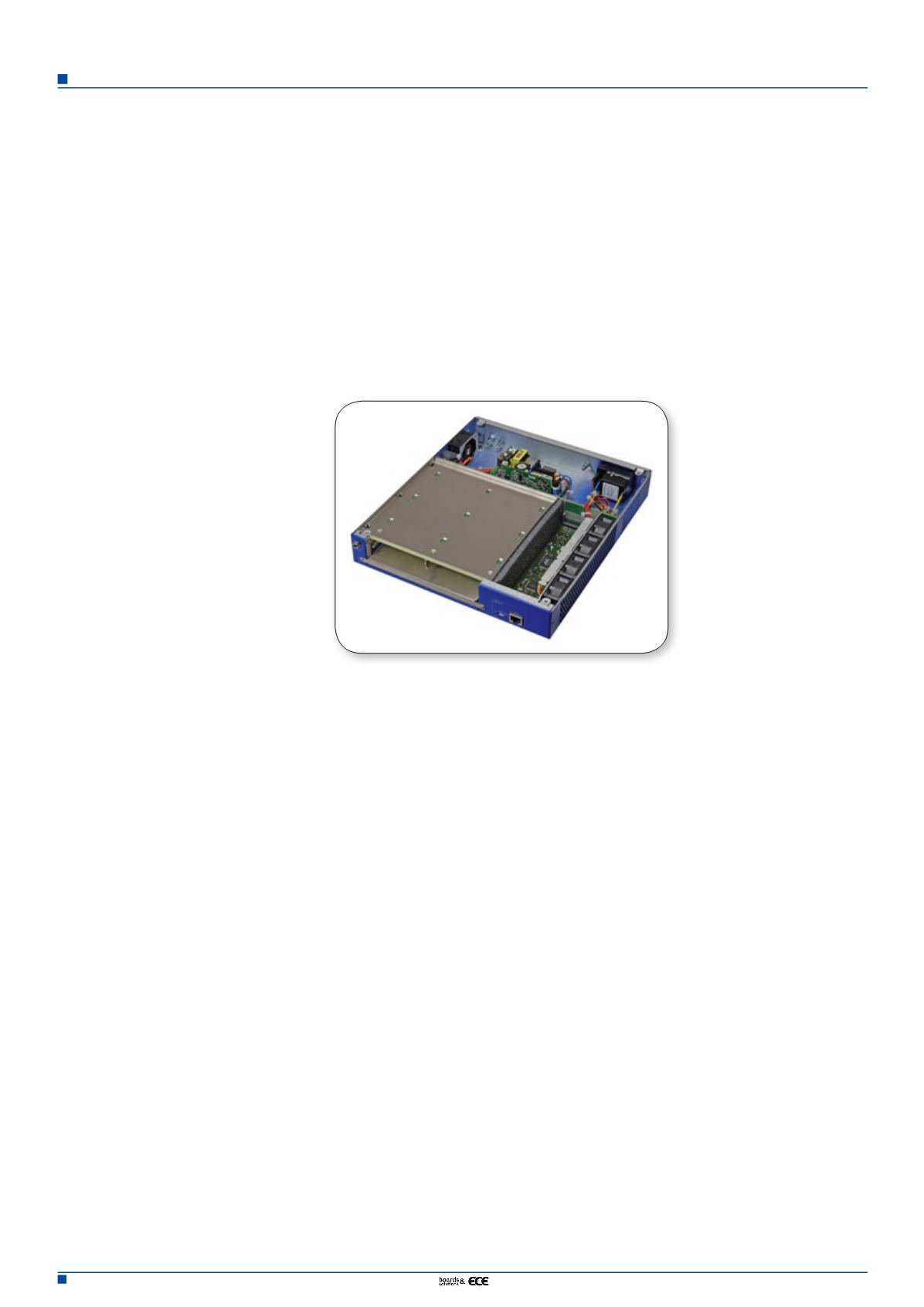
Figure 1. 2-slot MicroTCA with
embedded MCH (eMCH)


