May 2016
22
I
ndustrial
C
omputing
is no difference in function or performance
between the regular CU and the low cost CU.
Besides cooling and power supply, the back-
plane of the system is another important
device with huge impact on performance. The
common purpose of a backplane is inter-
connection between all devices, including
but not limited to the AMC modules. A high
data transfer rate requires sophisticated rout-
ing as well as test capabilities to ensure signal
integrity. As mentioned already, MicroTCA
offers different interface protocols for high
speed data transfer. SATA, Fat Pipe and the
Extended Fat Pipe for PCI Express, SRIO and
XAUI are connected between the two slots
and offer a data transfer rate of up to 64Gbs.
Another highlight of this system is the embed-
ded MicroTCA carrier hub. Why does such
a small system need a MCH? For N.A.T. as
well as for Pentair it’s very important to main-
tain their products within the standards of
PICMG. So, the major goal here is to provide
an attractive platform with regard to commer-
cial and technical aspects and still keep the
whole system compliant to the open standard
specification. The eMCH supports and man-
ages the AMC modules, the cooling units and
the load sharing of the system. As soon as an
AMC is inserted the MCH starts communica-
tion through the IMPI bus, reads the e-keying
of the AMC and enables the power once the
AMC is identified. Further the eMCH pro-
vides the clocking and a 1Gbit Base fabric to
both AMC slots and a 1Gbit uplink through
the systems front panel. That allows full man-
agement and fault isolation of the power sup-
ply, the cooling unit and of course the AMCs.
Another important function of the eMCH
is hot swap ability. This allows the user to
remove or insert AMCs even during oper-
ation. The feature was originally required
for high availability systems in the energy or
telecom market. Even for systems in automa-
tion or transportation applications it may be
important to replace an AMC without the
need to shut down the system. Via SNMP or
RMCP the MTCA system can be integrated
in existing management architectures. The
intended configuration can be set through
NATView, which is a visualization and man-
agement tool for MicroTCA. The embedded
MCH is fully compatible to all existing NAT
MCHs, which maintains a clear migration
path from a small system to a larger system
in case the application grows and requires a
larger infrastructure.
The simple construction of the system makes
it very service-friendly; individual compo-
nents are easy to replace or maintain. The top
cover can be removed by undoing a few screws,
allowing the fan unit and air filter to be easily
replaced. Small indentations in the base and
top plates allow rubber feet (included) to be
attached. This feature allows for stacking of
multiple systems and therefore scaling the
number of slots. With the 2-slot MTCA Sys-
tem with embedded MCH Pentair offers a real
turnkey solution. The user does not need to
care about the environment including hous-
ing, cooling and power supplier. By inserting
the appropriate AMC modules, the appli-
cation can be easily created. With the man-
agement features the system provides a high
grade of performance and reliability. Any fail-
ures are predictable and can be isolated and
eliminated before they occur. The open stan-
dard approach reduces the engineering cost
and optimizes the time to market. Further it
offers a high grade of flexibility to keep the
application always up-to-date.
n
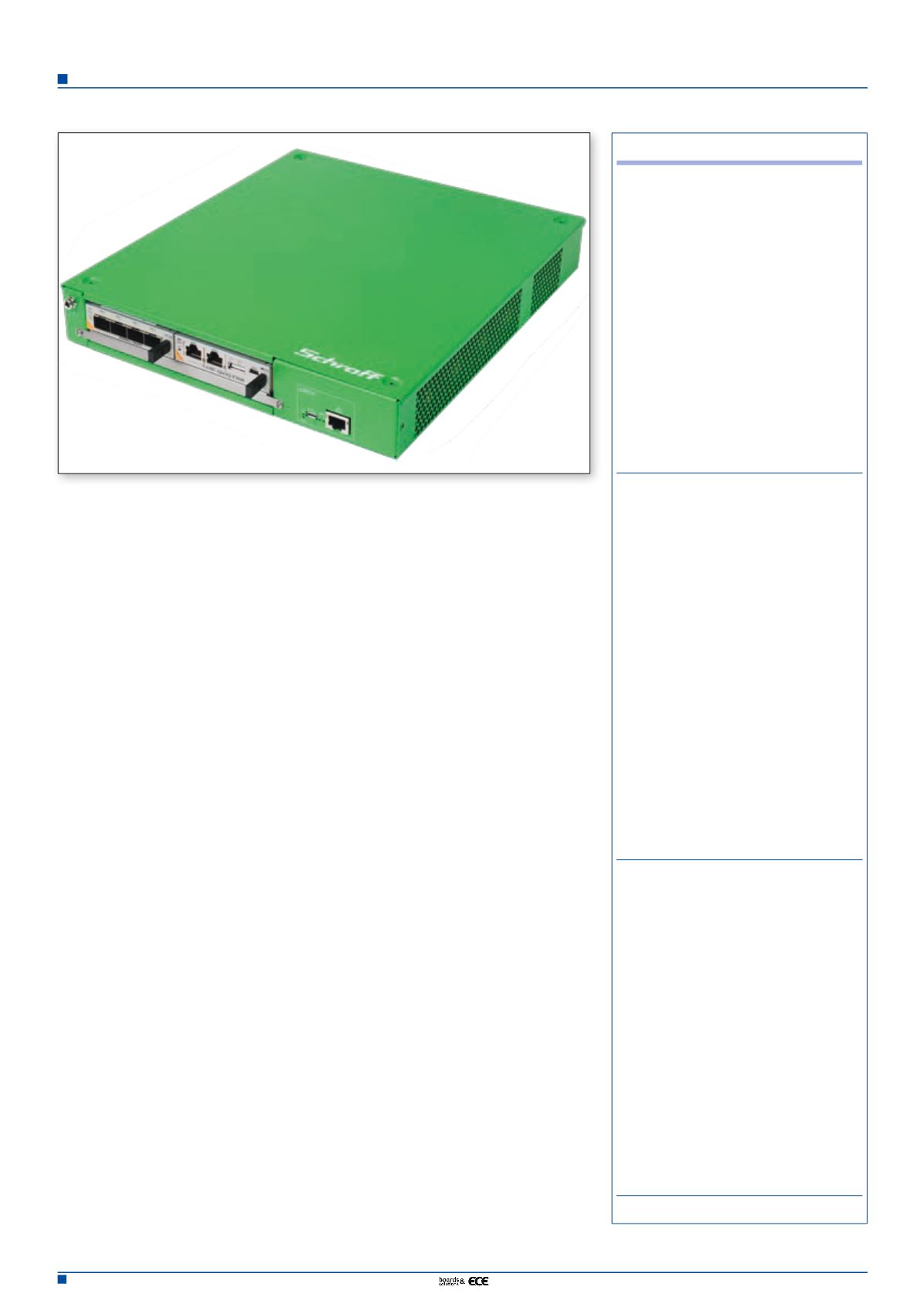
Figure 4. 2-slot MTCA System with eMCH
Product News
Pentair: small form factor cases
for various board standards
Pentair offers customized cases with fanless
(conduction) cooling based on the Schroff
Interscale platform for the most common
board standards: ATX, Micro ATX, Mini-
ITX, Embedded NUC, Pico ITX, Raspberry
Pi 2 Model B as well as Arduino.
Small universal cases with efficient heat dis-
sipation are in great demand. While pro-
cessor performance is increasing steadily,
systems are becoming smaller and must
also support the increasing heat dissipation
requirements of different bus standards used
in embedded and automation deployments.
congatec: COM Express module
with new AMD G-Series SOC
Congatec has expanded its COM Express
portfolio with the launch of the new AMD
G-Series SOC (called Brown Falcon). Com-
pared to modules based on the previous
generation of AMD Embedded G-Series
SOCs, the new conga-TR3 with dual-core
AMD GX-217GI processor provides up to
30% more graphics performance and 15%
more overall system performance. Addi-
tionally, the AMD G-Series SOC supports
faster and more power-efficient DDR4
memory, PCI Express Gen 3.0 for demand-
ing customer-specific extensions as well as
very powerful DirectX 12 graphics acceler-
ation. This positions the new module as the
first choice for many mainstream embedded
applications. With a maximum configurable
TDP of 12-15 watts, it is also ideal for fanless
designs.
Syslogic: fanless box PC for
industrial automation
With its Compact M series, Syslogic is set-
ting its sights on the automation market.
Thanks to the quadcore processor from the
Intel Atom E3845 series, the Box PC mas-
ters demanding control tasks and their visu-
alization. And its interface allocation has
been tailor-made to meet the requirements
of automation specialists. For the first time,
a Syslogic device features switchable COM
interfaces. These interfaces can be config-
ured as an RS232 or as an RS422/485 with
galvanic isolation. The basic configuration
also includes LAN, CAN, USB and Ether-
CAT interfaces. Optionally, the device can
additionally be fitted with WLAN, GSM,
UMTS and LTE.


