May 2016
39
D
evelopment
T
ools
The real costs of failed
design collaboration
By Ben Jordan,
Altium
This article explains in detail the need
to change the engineering world of
our fathers, so as to keep pace with
the challenges of the future and be
able to design the next generation of
connected electronic products.
All over the world, engineers are tasked
with designing ever denser, smaller, and
smarter products. To design something that
is small and powerful requires a design pro-
cess that is tightly aligned across all engineer-
ing domains. There are a number of product
design trends underway – below are just a
few that are directly impacting how engineers
work together:
Look at the news any day of the week, and
you’re bound to see a new story about
self-driving vehicle technology. This surge in
sophisticated electronics introduces a need
for a workflow that tightly integrates the elec-
trical and mechanical sides of the design pro-
cess. Not only do engineers have to deliver a
finished product, but they need to deliver one
that adheres to the strict safety requirements
for human transportation.
We’re nearing a future with growing depen-
dency on connected products where every
product we interact with will transmit some
form of data. What was once considered a
dumb product, like a light bulb, will trans-
mit data about its current state. Forgot to lock
your house? Do it from your smartphone,
while you’re at work. The way we interact with
the basic physical objects in our world is going
to change in a big way as electronics becomes
integrated into everyday household products.
With the release of the Apple Watch, wearable
technology has finally entered the realm of
mainstream technology. And with this surge
in interest comes an even greater demand on
design processes. Not only are these devices
small, they also are flexible, and PCBs need to
accommodate this with rigid-flex sections.
Despite the reality of the changing product
experience, the same tired design practices
that focus not on collaboration, but on treat-
ing everyone involved in the design process
as an isolated specialist, are employed day in
and day out. In many ways, companies are still
clinging to the ideals of the industrial era of
engineering, when what is needed is quite the
opposite. We’re still relying on the same tech-
nology that was introduced decades ago, such
as the following.
Interchange file formats. We know these well
because many packages of data are tossed back
and forth between electrical and mechanical
design teams. In goes the intelligent and com-
plex design intent of a PCB into a black box,
and out comes a basic board shape that com-
municates zero design intent to the mechani-
cal designer. This process occurs every single
day, in every engineering workflow. STEP files,
IDF, DXF – the design intent gets crammed
into these boxes and sent out to other engi-
neering teams. And what happens when they
get it? They have to tweak the data before it
ever works. Spending hours trying to adjust
that PCB or mechanical data before it’s in a
usable state.
Linear design processes. Companies are still
trying to survive on the industrial engineer-
ing era’s design methods. Assembly lines
worked great, back in the days when products
were static and standalone, and thus each part
of the design process was easily replaceable.
We wanted more, and the design processes
delivered. Now engineers are building intel-
ligent products that communicate, yet design
teams don’t. We design our particular aspect
of a design with our specialized knowledge,
pass it down the line, and forget about it until
there’s a problem.
Unmanaged communication methods. Trying
to explain the complexity of a PCB in a dis-
connected series of one-way communications
like an email thread is wildly inefficient. How
has this ever worked? Even worse, sometimes
an email isn’t received on time. Maybe that
needed revision to the placement of a com-
ponent was buried somewhere in our inbox.
All the while, we keep on designing, with our
communication methods trying to catch up,
but more often holding us back.
The true costs of failed design collaboration.
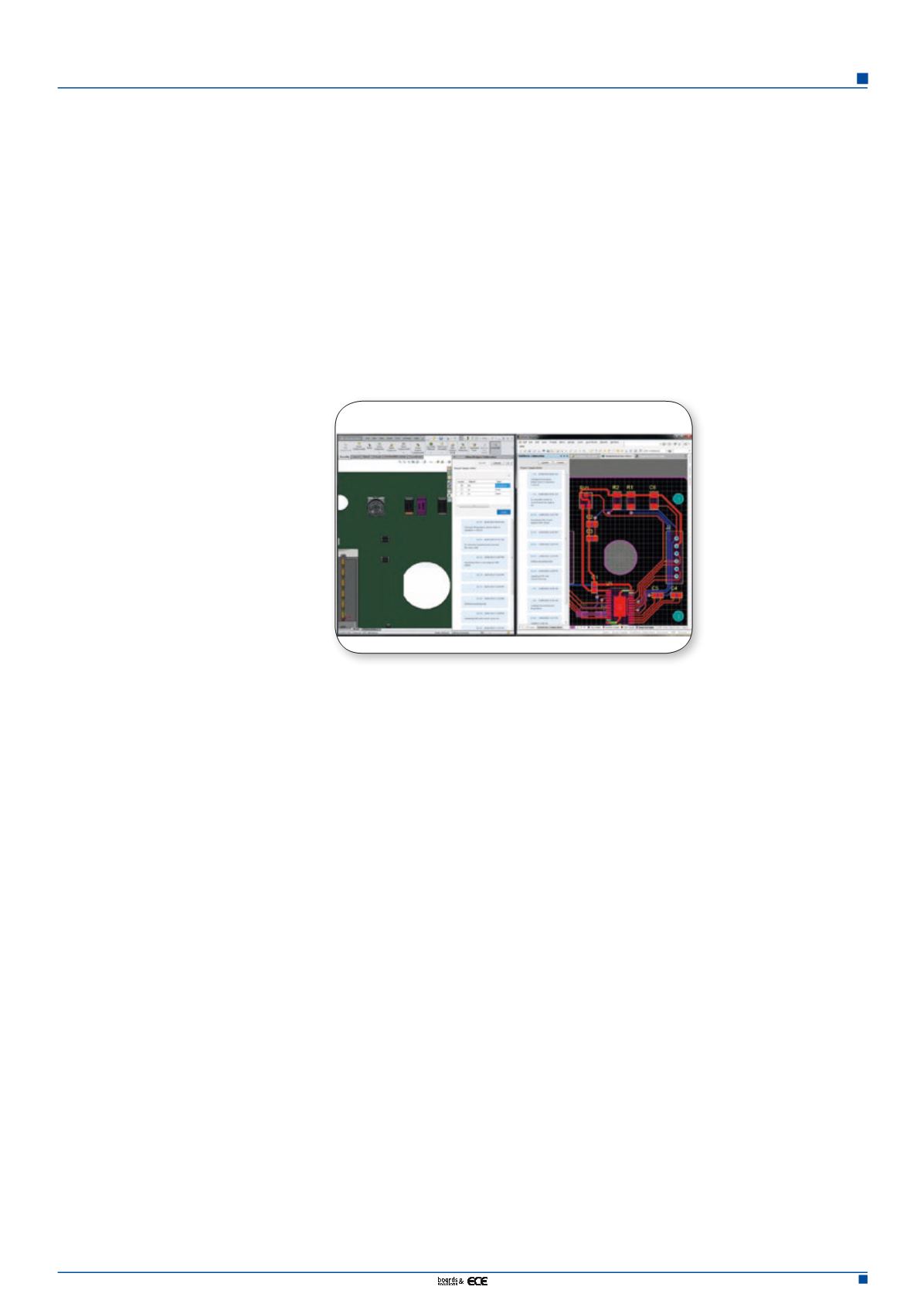
Figure 1. Example of a
parallel design workflow


