May 2016
38
D
evelopment
T
ools
enough to give a meaningful time measure-
ment with adequate resolution to say how
quickly the voltage entered the tolerance band.
Looking beyond the average voltmeter, there
are some high speed voltmeters that can mea-
sure tens of thousands of readings per second
with enough accuracy to detect when the
power supply voltage precisely enters the tol-
erance band. An example of this is the Key-
sight 34470A DMM. As transient recovery
times improve, these voltmeters, even captur-
ing data at 50K samples/second, become too
slow to capture the fast recovery time.
A scope would be a more reasonable tool to
use, as it can easily capture and visualize very
fast transients. The average scope, though,
typically has 1-3% vertical accuracy and 8-bit
resolution. Therefore, the average scope strug-
gles to provide enough vertical accuracy and
resolution to precisely locate when the DC
output voltage reaches the narrow tolerance
band. By putting the scope in AC coupling,
you try to zoom in on the tolerance band, but
error will be introduced as the post-transient
settled DC level will be distorted due to the
AC coupling. This could make it difficult to
precisely identify the post-transient DC level
within the tolerance band as the settled DC
voltage is being pulled down by the AC cou-
pling. Another option would be to leave the
scope in DC coupling, but use a large DC off-
set on the scope in order to zoom in on the
tolerance band. This works well with DC out-
puts in the 0-10V level, but as the DC output
climbs, the DC offset must also climb. With
big DC offsets, the minimum volts/division
must also increase to support the big DC off-
set, resulting in less measurement resolution
on the tolerance band.
For power supplies that have a wider voltage
tolerance band, scopes can be used to make
these measurements. In fact, Keysight Oscil-
loscopes offer built-in power analysis software
that makes transient response measurements
via turnkey operations. The highest perfor-
mance scopes, with 10 or 12 bits of resolu-
tion, have more flexibility and more advanced
front ends, allowing them to make these mea-
surements even for narrow voltage tolerance
bands, but these scopes are both expensive
and not as common on the average lab bench.
For power supplies with narrow voltage tol-
erance bands, a high performance power
quality analyzer, though, can make this mea-
surement – provided it has single shot mea-
surement capability. Single shot measurement
is needed because the transient is a single shot
event triggered by the rising edge of the cur-
rent pulse. Alternatively, if you can generate
a repetitive load current transient, such as a
square wave where the current jumps between
high and low current values, you can use a
power analyzer without single shot measure-
ment to capture the repeated transient event.
High performance power analyzers have bet-
ter than 0.1% vertical accuracy, 16-bit resolu-
tion and digitization speeds of 1M samples/
second or more. This combination of fast dig-
itization and accurate voltage measurement
allows you to easily measure power supply
load transient response and to identify when
the narrow tolerance band is reached. Since a
power analyzer can directly measure voltage
and current without probes, you can quickly
setup this measurement to trigger from the
rising edge of the current and then measure
the voltage recovery time.
n
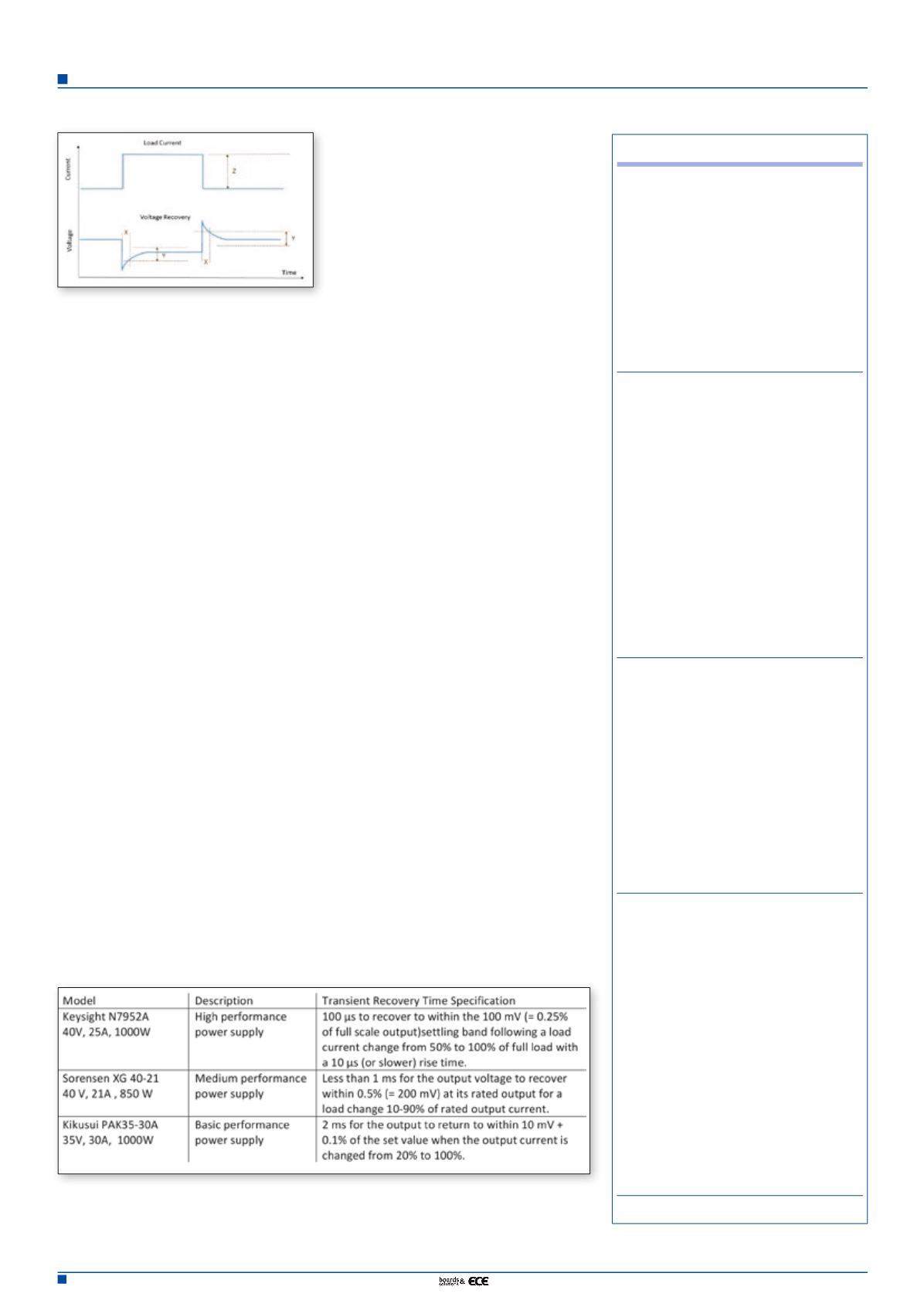
Figure 1. Load transient recovery time
general definition. Load transient recovery
time is the time “X” for the output voltage to
recover and to stay within “Y” millivolts of
the nominal output voltage following a “Z”
amp step change in load current, where: “Y”
is specified recovery band or settling band,
and “Z” is the specified load current change,
typically equal to the full load current rating
of the supply.
Figure 2. Examples of power supply transient recovery time specification. All models shown are
around 40V and 1000 W to ensure a like comparison.
Product News
Vector: latest release of VectorCAST/
Ada extends support for Ada 2012
Vector Software announces the latest release
of VectorCAST/Ada. VectorCAST/Ada is
a dynamic software test solution that auto-
mates Ada unit, integration, and system
testing, necessary for validating safety-crit-
ical embedded systems. This newest release
of VectorCAST/Ada incorporates many new
features and enhancements including:
Rohde & Schwarz implements
2-GHz modulation bandwidth in
SMW200A vector signal generator
With the introduction of the new R&S
SMW-B9 wideband baseband generation
option, Rohde & Schwarz is providing lead-
ing-edge baseband capabilities in its R&S
SMW200A high-end vector signal generator.
The R&S SMW-B9 option extends RF mod-
ulation bandwidth to 2 GHz enabling R&D
engineers to generate signals with extreme
wide bandwidth up to microwave frequen-
cies. No other vector signal generator in the
market offers a fully calibrated wideband
solution up to 40 GHz in a single device.
Digi-Key: Scheme-it design tool
with upgraded offerings
Digi-Key Electronics announced key
updates to Scheme-it and PCBWeb, two
influential design tools in its portfolio.
Scheme-it enables designers to quickly
sketch and document their concepts and
designs. With its electronic back-of-the-
napkin functionality, Scheme-it provides
the ideal environment for creative ideation
needs whether that is in block, icon, sche-
matic or board expansion format.
Mouser stocking Cypress
FM4 S6E2GM Pioneer Kit
Mouser Electronics is now stocking the
FM4 S6E2GM Pioneer Kit from Cypress
Semiconductor. This easy-to-use platform
allows developers to design with and eval-
uate the FM4 S6E2GM-Series of 32-bit
microcontrollers.
The
S6E2GM-Series
microcontrollers are based on the 180MHz
ARM CortexM4 processor with 1 MByte of
on-chip flash memory and 192 Kbytes of
SRAM. The kit enables rapid development
of high-performance embedded systems
using an Arduino Uno-compatible interface
to connect to Arduino shields for low-cost
hardware expansion.


