May 2016
37
D
evelopment
T
ools
Understanding and measuring power
supply transient recovery time
By Bob Zollo,
Keysight Technologies
Power supply transient recovery time
is the specification of a DC power
supply that describes how quickly
the power supply will recover from a
transient load condition on its output.
This article describes how you can
measure this feature easily and exactly.
With an ideal power supply operating in
constant voltage, the output voltage would
remain at the programmed value regardless
of the current being drawn out of the power
supply by the load. A real power supply, how-
ever, cannot maintain its programmed volt-
age when the load current rapidly rises. In
response to a rapid rise in current, the power
supply voltage will droop until the power sup-
ply regulation feedback loop brings the volt-
age back up to the programmed value. The
time it takes for the value to get back to the
programmed value is the load transient recov-
ery time. See figure 1.
Note that if the load current transient is not
a fast transient, but slowly rises or falls, the
power supply regulation feedback loop will be
fast enough to regulate and maintain the out-
put voltage without any visible transient. As
the current transient edge speed increases, it
exceeds the ability of the power supply feed-
back loops to keep up and hold the voltage
constant, resulting in a load transient event.
The power supply transient recovery time is
measured from when the load current tran-
sient begins to when the power supply set-
tles down and again reaches the programmed
value. But the programmed value must be
specified within a tolerance band. Thus, power
supply load transient recovery time is speci-
fied as the time required reaching a tolerance
band of some percent of the programmed
value, some percent of the rated output or
even a fixed voltage tolerance band. Figure 2
shows some examples of power supply tran-
sient specifications. Looking at the Keysight
N7952A power supply, you can see that the
transient recovery time tolerance band is
specified as 100 mV. If the output voltage is
25 volts, when measuring transient recovery
time, you must measure how long it takes the
power supply to recover back to within +/-
100 mV around 25 V.
Let’s look at an example application where DC
power supply transient response is important.
When testing power amplifiers (PA) used in
mobile devices (such as cell phones or tablets),
it is very important for the DC bias voltage
into the device under test (DUT) to remain at
a fixed and stable voltage. If the voltage were
to fluctuate or change during the test, the
proper test conditions are not maintained and
the resulting RF power measurements on the
DUT will not be correct.
In this case of the PA, the situation is exacer-
bated due to the current profile. The PA trans-
mits in pulses, and therefore pulls current
from the DC bias in pulses. These pulses have
fast edge rates and therefore present signifi-
cant load transients on the DC bias. Each time
the PA pulses on, it draws high current, which
drags down the DC bias power supply. The
power supply will recover quickly, but during
the time when the power supply is respond-
ing to the transient, its voltage is not at the
desired value for the test. Once the power
supply recovers, the PA will then be operat-
ing under the right test conditions and the RF
power measurements can be properly made.
With billions of PAs being manufactured and
tested each year, test throughput is critical. If
the power supply recovers slowly, it adds test
time to the PA and therefore slows down man-
ufacturing test throughput. PA manufacturers,
therefore, look for fast recovery power supplies
to ensure they can achieve maximum manufac-
turing test throughput. They look to the tran-
sient recovery time specification to determine
which supply will be best for their application.
So, the power supply vendor needs to be able
to accurately measure power supply transient
recovery time in order to present the best pos-
sible specification for the PA manufacturers.
The challenging part of measuring load tran-
sient recovery time is determining when the
voltage enters the tolerance band. While the
average voltmeter can easily measure if the
DC output voltage is within the tolerance
band, the average voltmeter is a slow instru-
ment and will not be able to sample fast
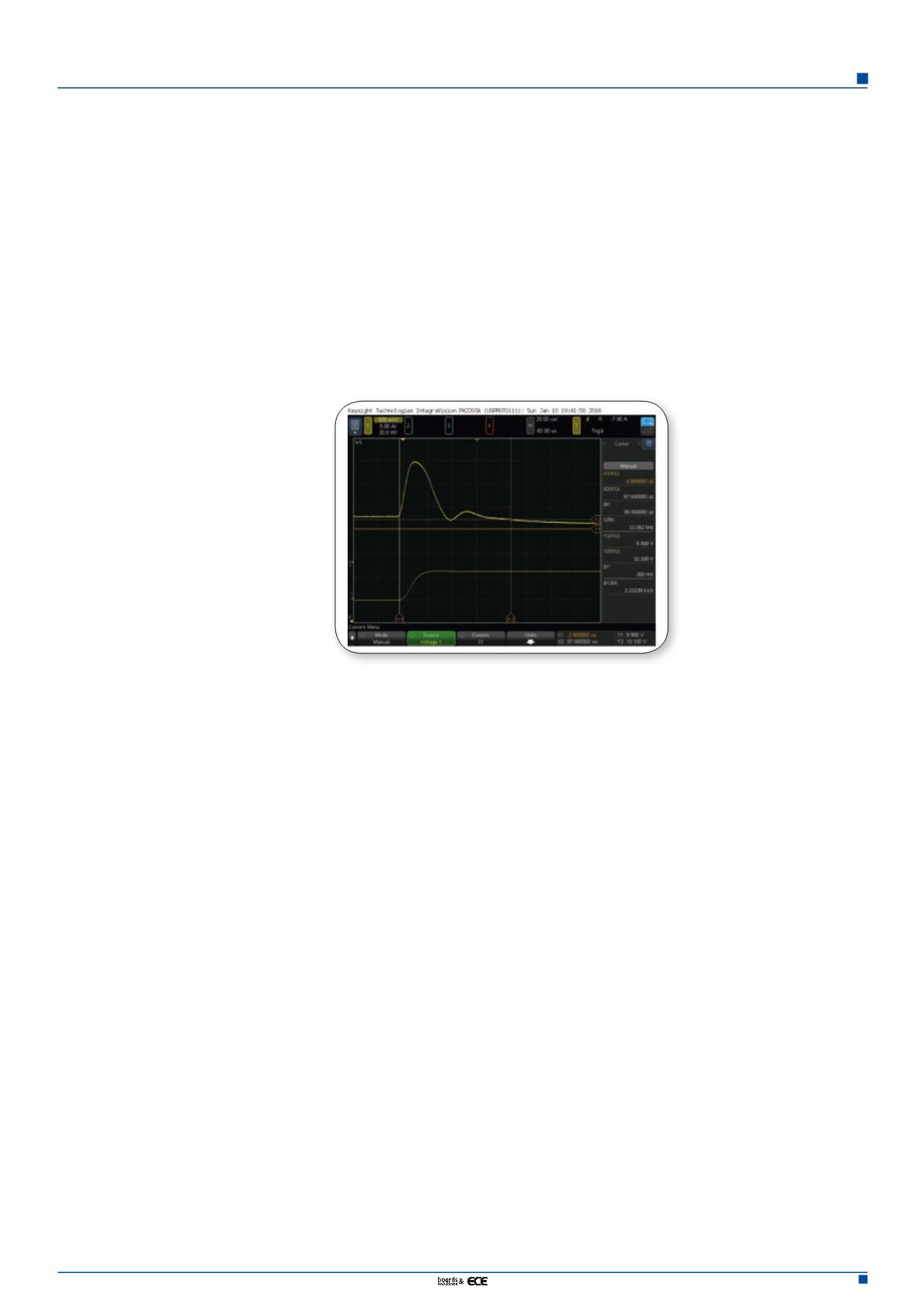
Screenshot of the Keysight
IntegraVision power analyzer
showing voltage transient
recovery time measurement.


