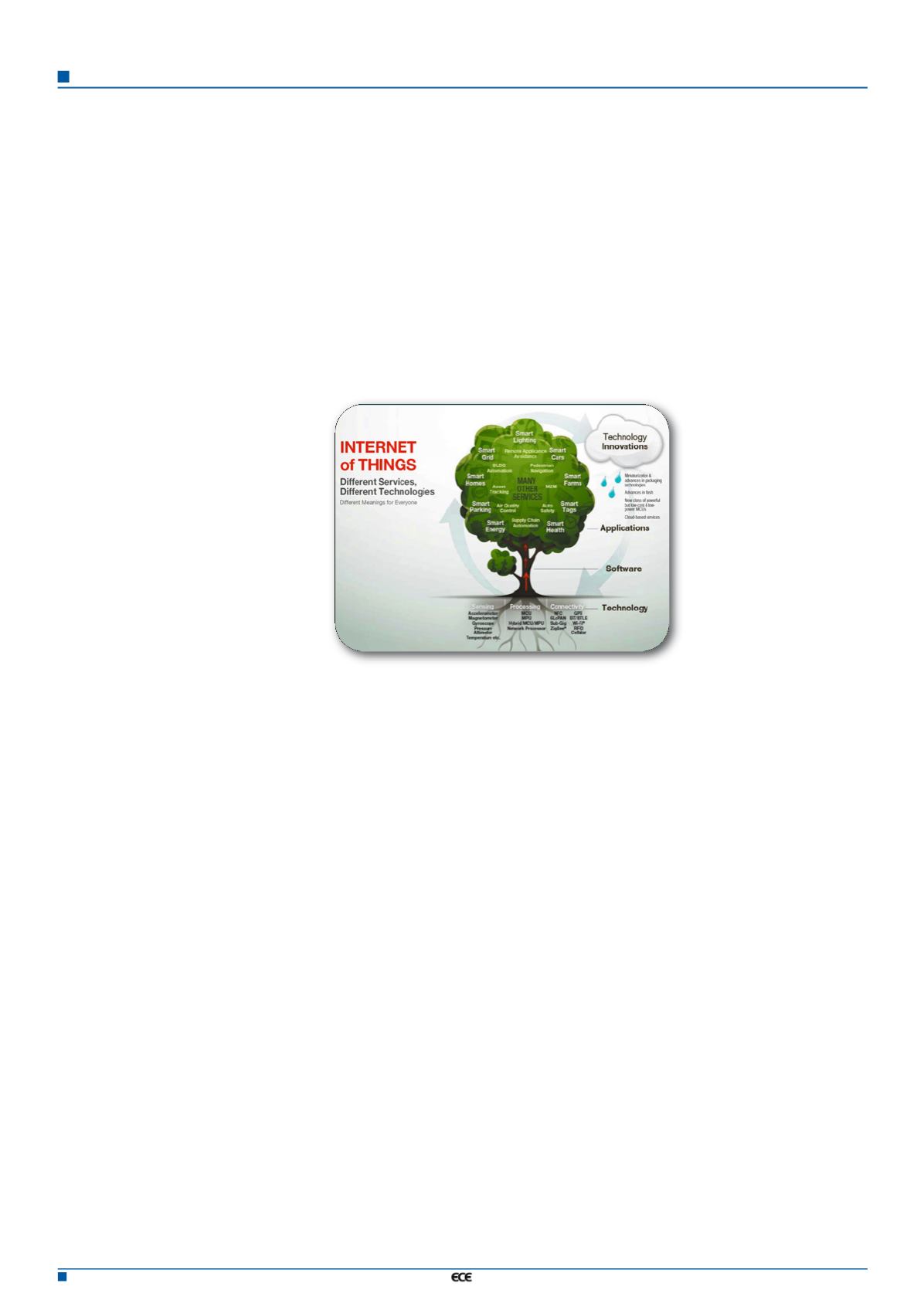
So, what does it really mean when something
is smart, and what makes an object smart?
Today, we are seeing the electrification of the
world around us. Almost all manufactured
goods now include an embedded processor
(typically a microcontroller, or MCU), along
with user interfaces, that can add programma-
bility and deterministic command and control
functionality. The electrification of the world
and the pervasiveness of embedded processing
are the keys to making objects smart. After a
device becomes smart through the integration
of embedded processing, the next logical step
is remote communication with the smart
device to help make life easier.
Communication capability and remote manual
control leads to the next step … how do I au-
tomate things and, based on my settings and
with sophisticated cloud-based processing,
make things happen without my intervention?
That is the ultimate goal of some IoT applica-
tions, and these capabilities can then enable a
new class of services that make life easier for
their users. For the network, sophisticated
cloud-based processing requires a new genera-
tion of communications processors and build-
ing secure networks that keep up with demand,
while simultaneously reducing energy con-
sumption and cost of equipment. This will re-
quire all kinds of innovations, well beyond
the improvements Moore’s law can deliver.
Let’s look at some categories for IOT-related
applications. Category one encompasses the
idea of millions of heterogeneous aware and
interconnected devices with unique IDs inter-
acting with other machines/objects, infrastruc-
ture, and the physical environment playing a
remote track, command, control and route
(TCC&R) role. Here, safety and security are
paramount. These applications are about ex-
tending the automation and machine-to-ma-
chine (M2M), machine-to-infrastructure (M2I)
and machine-to-nature (M2N) communica-
tions that can help simplify people’s lives. The
second category is all about leveraging the
data that gets collected by the end nodes
(smart devices with sensing and connectivity
capability) and data mining for trends and be-
haviors that can generate useful marketing in-
formation to create additional commerce. This
second category, especially, spurs discussions
about privacy, security, governance and the
social responsibility that comes along with
such a self-aware, connected world. This article
is focused on category one.
When devices can sense and communicate via
the Internet, they can go beyond local embed-
ded processing to access and take advantage
of remote super-computing nodes. This allows
a device to run more sophisticated analyses,
make complex decisions and respond to local
needs quickly, often with no human interven-
tion required. Here follow the most common
use cases for the Internet of Things. Pervasive
remote tracking/monitoring and command,
control and routing (TCC&R): this refers to
remote tracking/monitoring and, if needed,
command, control and routing functions for
tasks and processes usually done today manu-
ally, or, if done remotely, that require additional
infrastructure. Asset tracking: an extension of
these kinds of services is asset tracking, which
today is done via barcode and a variety of
manual steps, but in the future will leverage
smart tags, near-field communication (NFC)
and RFID to globally track all kinds of objects,
interactively. Some telehealth-related services
also belong in this category. Process control
and optimization: various classes of sensors
are used for monitoring and to provide data
so a process can be controlled remotely. This
task can be done in real time by sending the
data to a remote computer, analyzing it and
bringing a command back to the line so various
control actions can be taken to improve the
process … without any human intervention.
Resource allocation and optimization: the
smart energy market provides an ideal example
of this use case – accessing information about
energy consumption and reacting to the infor-
mation to optimize the allocation of resources
(energy use). Context-aware automation and
decision optimization: this most fascinating
category refers to monitoring unknown factors
Requirements for realizing the
Internet of Things
I
NTERNET OF
T
HINGS
By Kaivan Karimi and Meera Balakrishnan,
Freescale Semiconductor
The Internet of Things covers
many aspects of life –
from connected homes and cities,
to connected cars and roads,
to devices which track
an individual’s behavior and
use the data collected
for so-called push services.
October 2013
8


