from offshore wind parks to in-land stations with
minimized losses in submarine cables. In both cases
very efficient and reliable power semiconductors
utilized in the voltage conversion from AC to DC
and vice-versa are key devices.
Grids need to be monitored in a constant and effi-
cient way. Important information such as line
load, temperature and humidity must be provided
continuously from a vast number of nodes to a
control station which manages the line and, in
case of a failure, activates backup energy paths to
prevent massive blackouts. Reliable sensing tech-
nology and communication is needed to allow ef-
fective grid monitoring. The increasing need for
distributed grid monitoring and control creates
new problems in terms of cyber security. Privacy
and protection against frauds and malicious attacks
must be ensured. Thanks to the smart grid, an im-
portant milestone can be reached: the energy we
need to deliver 85W to a home can be reduced
from 220W to less than 100W. Great! But this is
still not enough. The next step is to make sure we
consume energy more efficiently, so that the needed
load can shrink to 50W instead of 85W. This will
automatically turn in an even higher saving in en-
ergy generation.
Smart meters serve as the point of demarcation
between utilities and end-consumers. They allow
utilities to collect near-real-time energy consump-
tion data and communicate with devices inside
customers’ homes and businesses. The assembled
data translates into actionable information to re-
duce consumption, save money on energy bills,
and maintain the reliability of power service with-
out having to fire additional generators at peak
times. As the market landscape changes from pilot
project to mass scale deployment, solutions need
to be cost-effective yet enriched with features. The
paramount concern of end users - security - needs
to be incorporated in design rather than as addi-
tional feature. Infineon’s dedicated smart meter
portfolio covers key paramount realms of smart
meter design from the outset, with feature-rich,
cost-effective, secure-by-design devices.
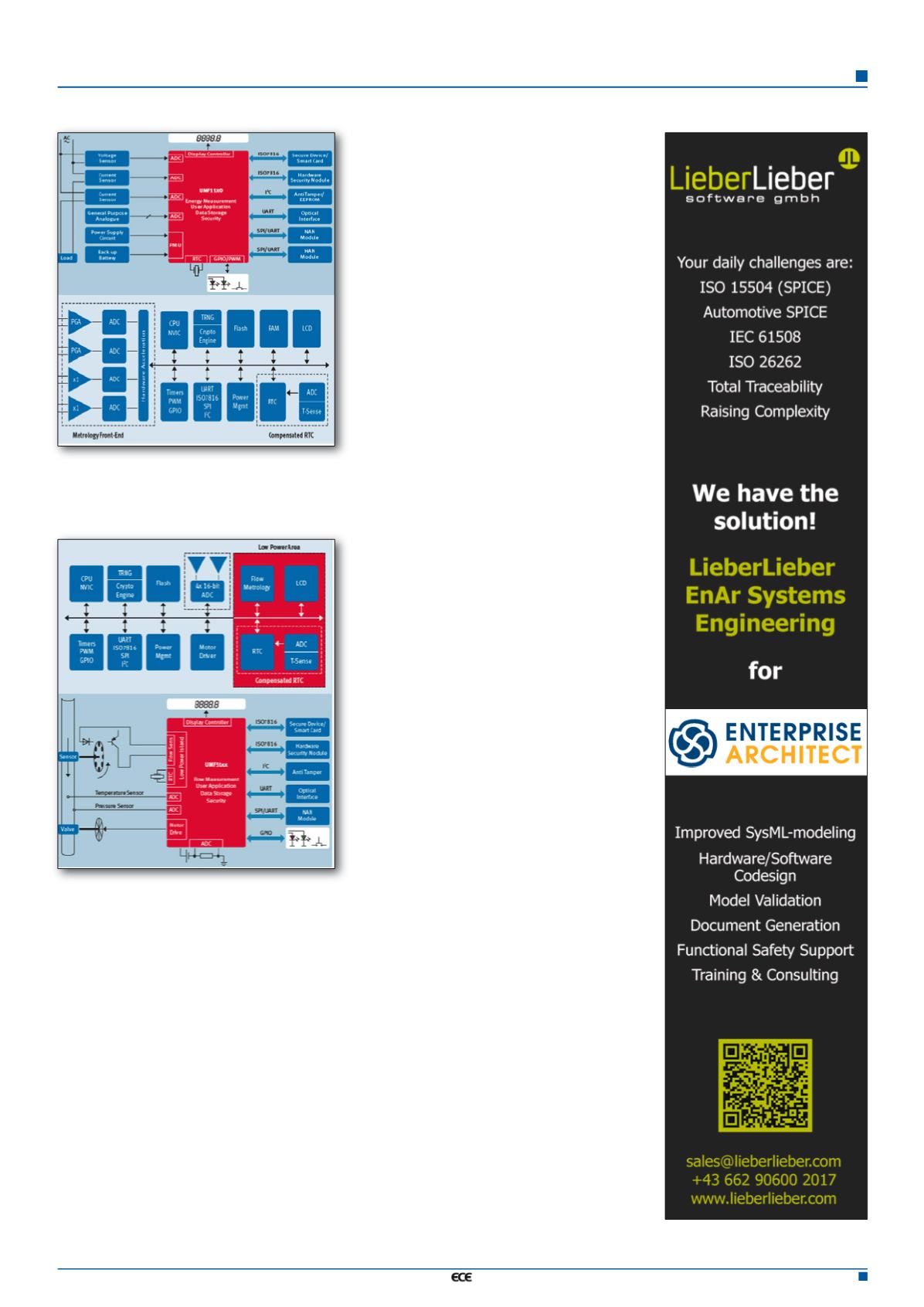
The UMF 11x0 IC targets single-phase meters
based on Cortex M0 with maximum CPU speed
64MHz. Embedded flash memory blocks - fully
qualified for a high number of write cycles and
data retention over an extended temperature range
- help drive down total system cost. Further, an in-
tegrated high precision analog front-end (AFE)
supports all current and voltage sensing technolo-
gies. The flexible and software configurable power
management unit adapts to product requirements
across different geographic conditions, and a vast
number of peripherals provide outstanding flexi-
bility. The highly accurate, temperature-compen-
sated, low power real-time clock adds to the list of
value-add features alongside the integrated low
power LCD driver.
The device incorporates a dedicated configurable
CPU privileged mode which runs metrology and
cryptography functions in a dedicated, protected
environment which is virtually separated from all
other application tasks. Secure and reliable running
of the certified metrology software is ensured
while circumventing the meter manufacturers’ has-
sle of getting application software approval from
regulatory bodies for each update. This not only
adheres to MID statutory obligations but also
substantially downsizes cumbersome operational
activities at both meter manufacturer and regulator.
Like the electric grid, the flow system infrastructure
tends to be old and patchwork. Non-revenue water,
namely leaks and water theft, is a huge issue across
the planet. Additionally, battery-operated flow
15
October 2013
M
ETERING
Figure 1. The UMF 11x0 IC targets single-phase
meters based on Cortex M0 with maximum CPU
speed 64 MHz (block diagram and typical appli-
cation).
Figure 2. The flow meter IC (UMF51x0) is
designed with the specific target of gas, water and
heat metering.


