11
October 2013
I
NTERNET OF
T
HINGS
to the cloud. Some companies promote that all
devices will be dumb nodes, with all processing
and decision-making done within their cloud.
Alternatively, some believe only minimal access
to the cloud for basic Internet-related services
will be required, with most of the thinking done
locally. The architecture and building blocks of
the IoT as described in this paper allow for a
number of different approaches, which will likely
be necessary due to the wide variety of use cases
and configurations anticipated. That flexibility
will be needed to optimize system-level
performance.
Without a solid security mechanism for all of
the IoT building blocks mentioned above, the
IoT will not be as pervasive as it is anticipated to
become. When we say security, we really mean
security of information – the information that
gets passed around by various parts of the system
and is context- and service-dependent. Here’s
what we mean by secure information: informa-
tion needs to be available when needed, infor-
mation needs to be confidential, and the integrity
of data needs to be assured. The security of the
system is as good as the last threat it was able to
prevent, and, as soon as it gets broken, one
needs to implement new ways of making it
secure again. There are different types (MCU,
hybrid MCU/MPU, integrated MCUs, etc) and
layers of embedded processing at various nodes
of the IoT, and for any device to be considered
smart so it can be connected to the Internet, it
must incorporate an embedded processor.
Embedded processors are going to be pervasive
in the IoT, and they’d better be very secure.
By now it should be clear that networks of the
future will connect more objects, machines and
infrastructure to a global neural network of
cloud-based services than they will connect
people. At the heart of the IoT are layers of
embedded processing, from the most remote
satellite sensing node to the core of the network.
The diversity of services being planned for the
IoT means no one company can develop full so-
lutions and supporting IoT-based innovations.
IoT-based innovations will require a broad, rich
ecosystem of partner companies working together
to bring IoT-based services to the market. An
open (non-proprietary) platform that allows all
partners working together to use the same base-
line technologies is key to making the IoT
happen.
The pervasiveness of embedded processing is
already apparent everywhere around us. Home
appliances like a toaster now come with an em-
bedded MCU that not only sets the darkness of
the piece of toast to your preference, but also
adds functional safety to the device. There are
energy-aware HVAC systems that can now gen-
erate a report on the activity in your house and
recommend ways to reduce your energy con-
sumption. The electrification of vehicles has al-
ready started happening. The cars of the future
will indeed be able to drive themselves. Similar
changes are also happening in other aspects of
our lives … in factories, transportation, school
systems, stadiums and other public venues.
Embedded processing is everywhere.
Connecting these smart devices (nodes) to the
web has also started happening, although at a
slower rate. The pieces of the technology puzzle
are coming together to accommodate the Inter-
net of Things sooner than most people expect.
Just as the Internet phenomenon happened
not so long ago and caught like a wildfire, the
Internet of Things will touch every aspect of
our lives in less than a decade. Are you ready
for it?
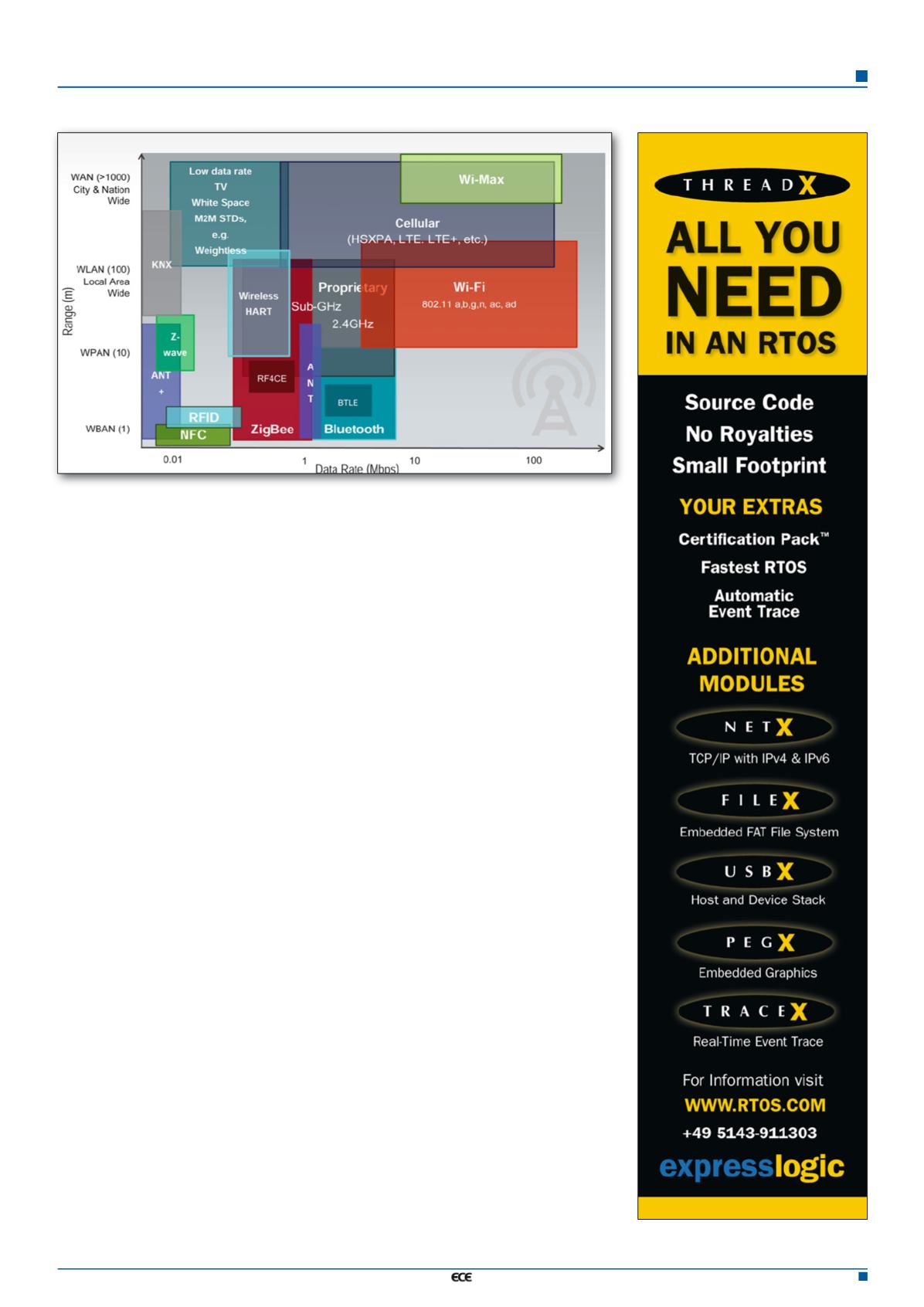
Today’s wireless landscape


