A major task of many motor control units,
data recording systems and industrial process
control units, as well as many different current
measurement and monitoring applications, in-
volves transmitting measurement data delivered
by sensors to the control electronics. In drives
for example, the currents and link voltage must
be measured. The sensors required for this are
directly integrated into the power circuit in
the HV system (high voltage) but the control
electronics works only with LV technology
(low voltage) at voltages of 5 or 3.3 V. In order
to prevent damage to people or property, the
sensor circuit must be galvanically isolated
from the control circuit for safety reasons.
There must be no electrical connection between
the two circuits. The methods and test standards
for galvanic isolation are very well-known to
the industry. Depending on the solution, three
different coupling procedures are used: capaci-
tive, inductive or optical.
A method that is particularly appreciated in
the industry, thanks to its robustness and reli-
ability, involves galvanically isolated sigma-
delta modulation, where the signals are trans-
mitted optically. At its output, converters of
this type supply a high-frequency data stream
of up to 25 MHz, as well as a clock signal. The
sigma-delta method works in a similar way to
pulse width modulation. If a value of zero is
present at the input, only zeroes are transmitted.
If the maximum value is present at the input,
the line permanently transmits the value one;
if the value present at the input is 50%, the
value one and the value zero are each trans-
mitted 50% of the time. The control electronics
evaluates this signal delivered by the sigma-
delta modulator. To evaluate these signals, EBV
customers frequently use an FPGA in which a
sinc3 filter has been implemented. In this re-
gard, the FalconEye reference design created
by EBV has proven to be of great value.
However, problems occur in some applications
when transmitting the 20 MHz signal to/from
the sigma-delta ADC because this signal does
not always pass through the line or the circuit
board without problems, or in an EMC-com-
pliant manner. Since this problem kept arising,
EBV started looking for a solution, and found
it in using a differential data stream for this
transmission. This is the very function that
EBV has now implemented. An Avago converter,
type ACPL-796J, which was already available
on the market, was used as the basis. This
product offers safe, TÜV-certified isolation be-
tween both sides. With regard to creepage dis-
tance, transient strength, protective circuits,
etc, the new EBVchip is in line with the ACPL-
796J, which has already proven itself on the
market. The new converter, designated ACPL-
798J, delivers a differential LVDS signal (low-
voltage differential signalling) at the output.
In this modified variant, the signals reach
their destination reliably in environments
where there is heavy electromagnetic interfer-
ence (EMI). As the ACPL-798J generates dif-
ferential output signals and the electromagnetic
interference affects both output lines simulta-
neously and with practically the same intensity,
the useful signal at the destination can be re-
covered by subtracting the two signals, while
the interfering signals caused in both lines
cancel each other out during this subtraction.
While the standard output, which issues a
signal against earth, works at a 5 or 3.3V level,
differential signal transmission via LVDS can
Optically isolated sigma-delta
modulator with LVDS interface
C
OVER
S
TORY
By Rolf Richter,
EBV Elektronik
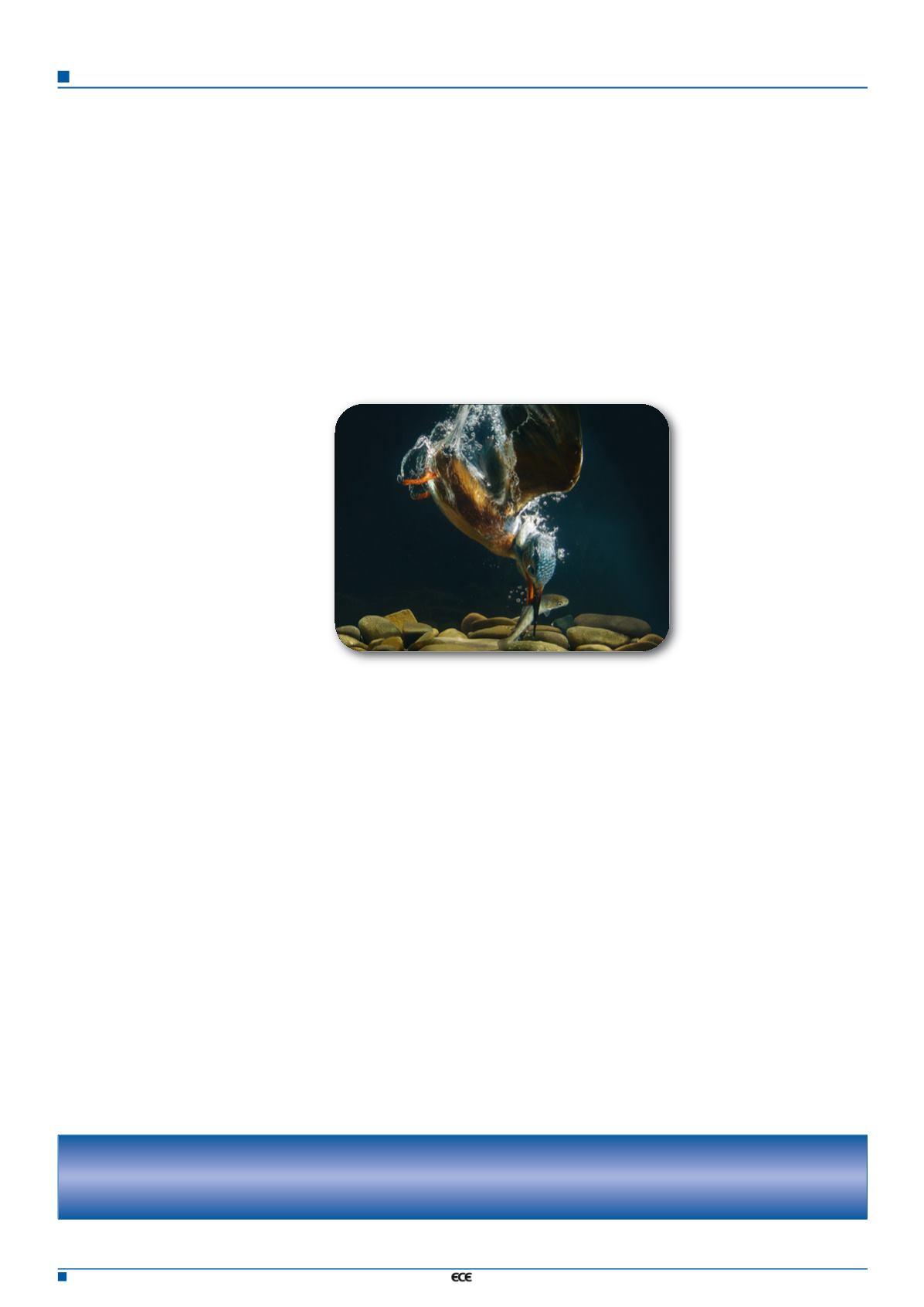
With its differential output,
the new Hunter EBVchip can
reliably transmit galvanically
isolated measurement signals
from sensors to digital
processing electronics, even
in environments with heavy
electromagnetic interference.
October 2013
6


