October 2013
10
I
NTERNET OF
T
HINGS
(environmental, interaction between machines
and infrastructures, etc) and having machines
make decisions that are as human-like as possible
… only better! For example, a traffic collision
avoidance system (TCAS) where a host of new
technologies available today and in development
that could allow vehicles to communicate with
each other as well as with a central control unit.
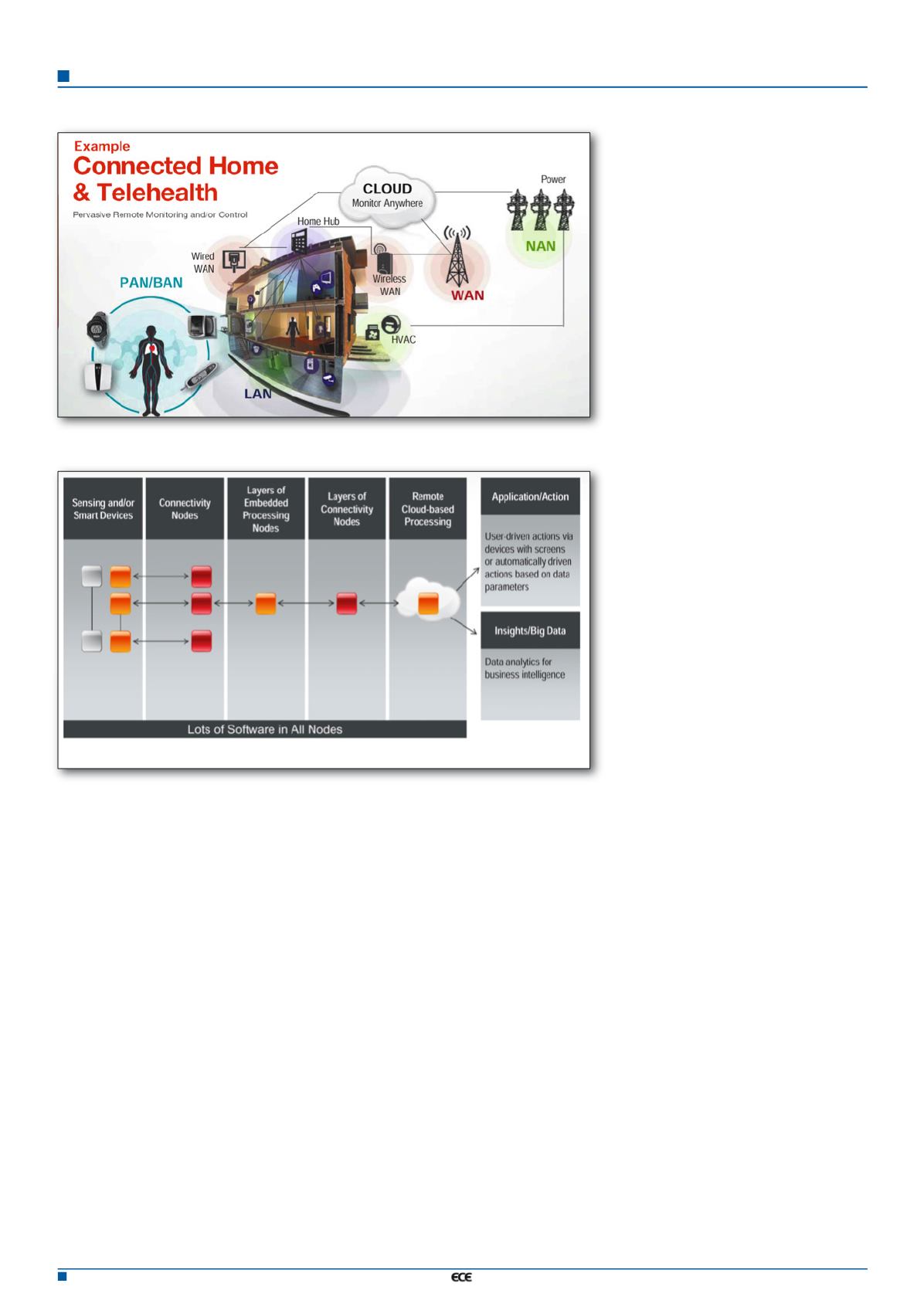
Requirements common to all of the use cases
above include: 1) sensing and data collection
capability (sensing nodes), 2) layers of local
embedded processing capability (local embedded
processing nodes), 3) wired and/or wireless
communication capability (connectivity nodes),
4) software to automate tasks and enable new
classes of services, 5) remote network/cloud-
based embedded processing capability (remote
embedded processing nodes), and 6) full security
across the signal path.
The types of sensing nodes needed for the In-
ternet of Things vary widely – e.g. a camera
system for image monitoring; water or gas
flow meters for smart energy; radar vision for
safety; RFID readers sensing the presence of
an object or person; doors and locks with
open/close circuits for smart buildings. These
nodes will all have a unique ID and can be
controlled separately via a remote command
and control topology. Use cases exist today in
which a smartphone with RFID and/or NFC
and GPS functionality can approach individual
RFID/NFC-enabled “things” in a building,
communicate with them and register their
physical locations on the network.
Embedded processing is at the heart of the
IoT. Local processing capability is most often
provided by MCUs, hybrid microcontrollers/-
microprocessors (MCUs/MPUs) or integrated
MCU devices, which can provide the real-
time embedded processing that is a key re-
quirement of most IoT applications. Use cases
vary significantly, and fully addressing the real-
time embedded processing function requires
a scalable strategy (using a scalable family of
devices), as one size will not fit all. There are a
few requirements that make an MCU ideal for
use in the Internet of Things: energy efficiency,
embedded architecture with a rich software
ecosystem, portfolio breadth that enables soft-
ware scalability, portfolio breadth that cost-ef-
fectively enables different levels of performance
and a robust mix of I/O interfaces, cost-effec-
tiveness, quality and reliability, and security.
The role of the communication node is to
transfer information gathered by the sensing
nodes and processed by local embedded pro-
cessing nodes to the destinations identified by
the local embedded processing nodes. And,
once the data is remotely processed and new
commands are generated, the communication
node brings back the new commands to the
local embedded processing nodes to execute a
task. The IoT will encompass all aspects of
one’s everyday life, hence there is no limit to
the distances for which command and control
communication can and will be used. The IoT
will also add the concept of wireless sensor
and actuator networks (WSANs), which are
networks that contain sensing and embedded
processing nodes that can control their envi-
ronment. As with any emerging market, a tran-
sition period before system optimization takes
place and technologies become better-suited
for the end IoT-related applications is likely.
Major volumes for the IoT market will likely
not happen for another 10-12 years, and, at
that time, the communications technologies
may be completely different from those being
considered today, or new revisions of existing
standards may have emerged. Alternatively,
there could be brand-new technologies better
suited for certain aspects of IoT communication
that displace the existing standards for the IoT.
Or, a disruptive wireless network technology
like Weightless
/)
is developing may take hold. One thing about
the connectivity needs of the future IoT market
is clear – it is so diverse, large and cost-conscious
that a range of different technologies will be
needed (possibly includingWAN, LAN,WPAN,
WBAN, etc.), and one size will not fit all. Re-
quirements for communication functions are
almost the same as for embedded processing
nodes: cost-effectiveness, low power, quality
and reliability, and security.
Getting all segments of the IoT to communicate
and work together is key to the success of the
technology rollout, and that means deploying
a lot of software (and middleware) that will
enable various heterogeneous devices to talk
with each other and the infrastructure around
them. Since there are not yet industry-wide
IoT best practices agreed upon and deployed,
many component providers are approaching
the connection between devices and the cloud
as a connection to their niche cloud, as opposed
Building blocks of the IoT
IoT example of connected home and telehealth


