October 2015
39
E
mbedded
W
ireless
Fast and secure roaming for wireless
applications on public transport
By Benjamin Amsler and Jürgen Kern,
NetModule
Fast and secure roaming is a term
associated with continuous mobile
M2M communication on public
transport vehicles. The number of
applications needing a seamless
connection with their counterpart
is rising rapidly. The precondition is
often the transmission of large
data volumes in real time into and
out of the vehicles.
The trend reversal in communications tech-
nology for safety-critical applications is par-
ticularly interesting, since it shows a move
away from the previously dominant propri-
etary systems to standardized protocols such
as 2G/3G/4G/WiFi. For example, this is seen
with communications-based train control
(CBTC) with extremely high demands on sys-
tem availability and secure communications
in trams, metro and light rail vehicles. For
some considerable time now driverless and
autonomous special vehicles have been real-
ity in production and distribution companies,
such as the container terminal at the port of
Hamburg, as well as fully automatic under-
ground railway systems, such as the metro
in Copenhagen. The trend towards complete
automation cannot be stopped - in the near
future many metro and tram systems will
“operate driverless”.
But, for several reasons, the existing cellu-
lar communications infrastructure does not
fully meet the requirements expected by these
applications: operators should be able to guar-
antee a seamless connection with maximum
availability and in the case of CBTC systems
for automatic train operation (ATO), a redun-
dant network infrastructure is absolutely
essential because of the security requirements.
Furthermore continuous 24/7 communica-
tion incurs considerable costs and often, the
network capacities are not sufficient enough,
especially when offering passenger WiFi,
ultimately, there is high dependency on the
network operator. To counter these deficits
companies establish proprietary and dedi-
cated networks for M2M applications, mostly
based on IEEE802.11 WiFi in the 2.4GHz and
5GHz range, LTE or GSM-R. These networks,
however, are already reaching considerable
dimensions and reinforce the trend towards
an increasingly heterogeneous network land-
scape, where islands with the broadband tech-
nologies LTE and WiFi are emerging within
the extensive 2G/3G/4G coverage.
In the near future it is highly unlikely that one
communication technology will completely
prevail. Therefore solutions are required that
are reliably switching seamlessly between
2G/3G/4G/WLAN networks and can bun-
dle several links to obtain maximum capac-
ity. Standard devices mostly support seamless
roaming only between 2G/3G/4G; switching
between WLAN and cellular communications
is possible only using special protocol software,
e.g. the Mobile IP protocol. The interruption
of up to a few seconds associated with this
roaming method is largely unsolved - a situ-
ation that is not tolerable for many applica-
tions. There is, however, a possible approach
to solve this problem: short switching times
are a basic requirement for the change in tech-
nology, and to achieve this, standard modem
driver software could be optimised to shorten
switching delays. Based on this, it is then pos-
sible to operate several connections in paral-
lel, as a result of which the bandwidth can be
increased (link aggregation) and, on the other
hand, the interruption of a single connec-
tion does not lead to communication failure
(redundancy).
However, roaming within one communica-
tion technology when changing from one
network cell to the next is executed much
more frequently. Broadband networks such
as WLAN in particular, have a wireless range
that is physically limited to approximately
100m, which requires frequent cell changes
with increasing speeds. One example: a cell
with a range of 200m is crossed in 12s by a
vehicle traveling at 60km/h. Fast Roaming
is defined in the standard IEEE 802.11r and
is considered as a mechanism for optimiz-
ing this roaming time in encrypted WLAN
networks. It speeds up the Basic Service Set
(BSS) transition between the access points
(APs) thanks to an optimized negotiation
of the safety encryption in less than 100ms.
Compatibility with the IEEE 802.11r stan-
dard can usually be activated by means of a
software driver option. In addition to the nec-
essary technical fine-tuning there is a further
challenge with WLAN networks: in contrast
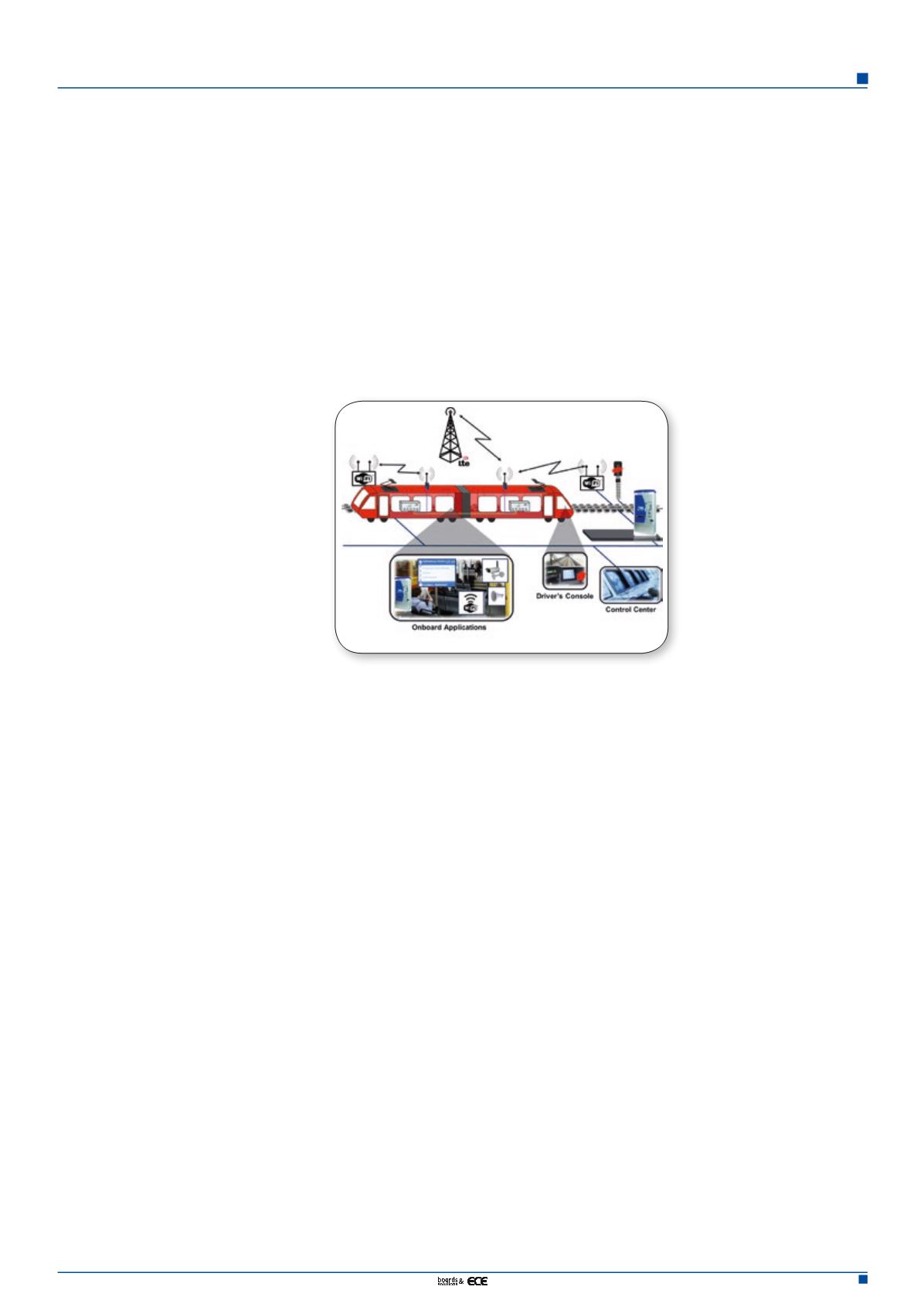
Figure 1. Several complementary
network technologies form
modern M2M communications
infrastructures in local public
transport networks.
(Source: NetModule AG)


