October 2015
35
E
mbedded
W
ireless
describes the data link layer as the collection
of functions that achieve media access control
and logical link control. This functionality
presents the perfect opportunity for dual- or
multi-protocol arbitration/multiplexing by
making two data link layers (of two different
protocols) aware of each other.
This mutual awareness can be best translated
in a set of rules that define the in-system coex-
istence of the two protocols. Rules can span
various levels of the data link layer implemen-
tation, from managing access to the physi-
cal resource (electromagnetic spectrum), to
managing duty cycles of the respective pro-
tocols. Some standardization bodies (such as
the Bluetooth Special Interest Group) have
already begun defining high-level sets of rules
for protocol arbitration, as described in Vol-
ume 7 of the Bluetooth specification Wireless
Coexistence, also known as the Mobile Wire-
less Standards (MWS)Coexistence. While
these rules are aimed mainly at coexistence
within the electromagnetic spectrum, they are
ideal for protocol arbitration as well.
To allow for scalability and modularity of the
system, it is important to achieve multiplex-
ing at a given level of the protocol stack, since
higher layers can become agnostic. There can
be cases where IoT application constraints
and needs may dictate otherwise, in the
sense that the topmost application layer will
evidently be aware of the fact that it has two
protocols at its disposal and leverage both of
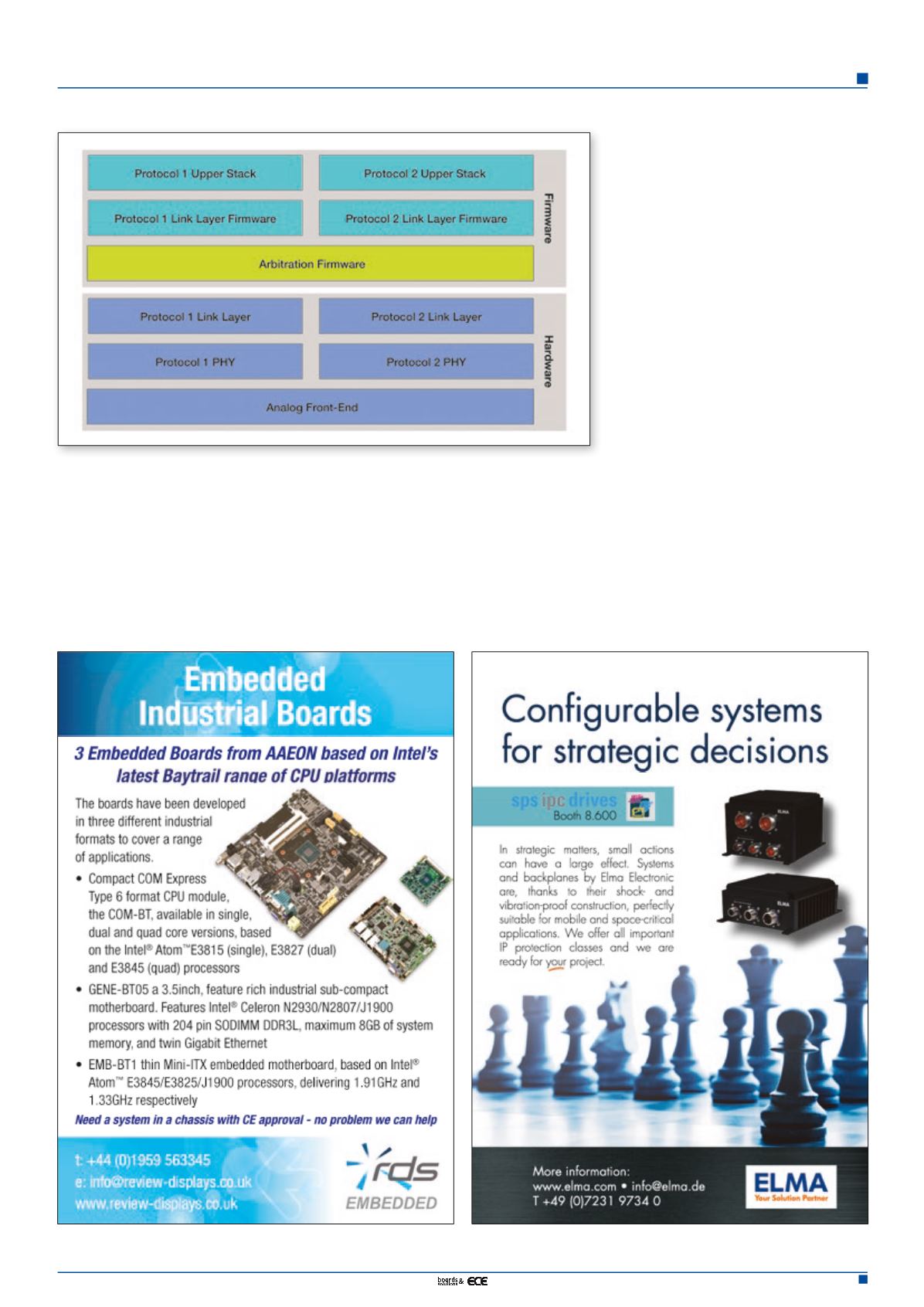
them to achieve the desired functionality. Fig-
ure 1 shows a proposed system decomposition,
where the protocol arbitration is achieved in
a firmware layer that runs directly above the
data link hardware. This approach eliminates
the gate count cost of having an on-chip com-
plex arbitration logic, which may be too rigid
at design time to cover all the corner cases
that can occur over the lifetime of a wireless
microcontroller used in IoT applications.
Figure 1. Link layer arbitration


