October 2015
36
E
mbedded
W
ireless
Freescale’s solution for addressing multi-wire-
less protocol in the ever-growing IoT space
is the Kinetis KW40Z MCU- an ARM Cor-
tex-M0+ based ultra-low power wireless
microcontroller platform. This platform
includes dual wireless protocol support for
Bluetooth Low Energy (BLE) v4.1 and IEEE
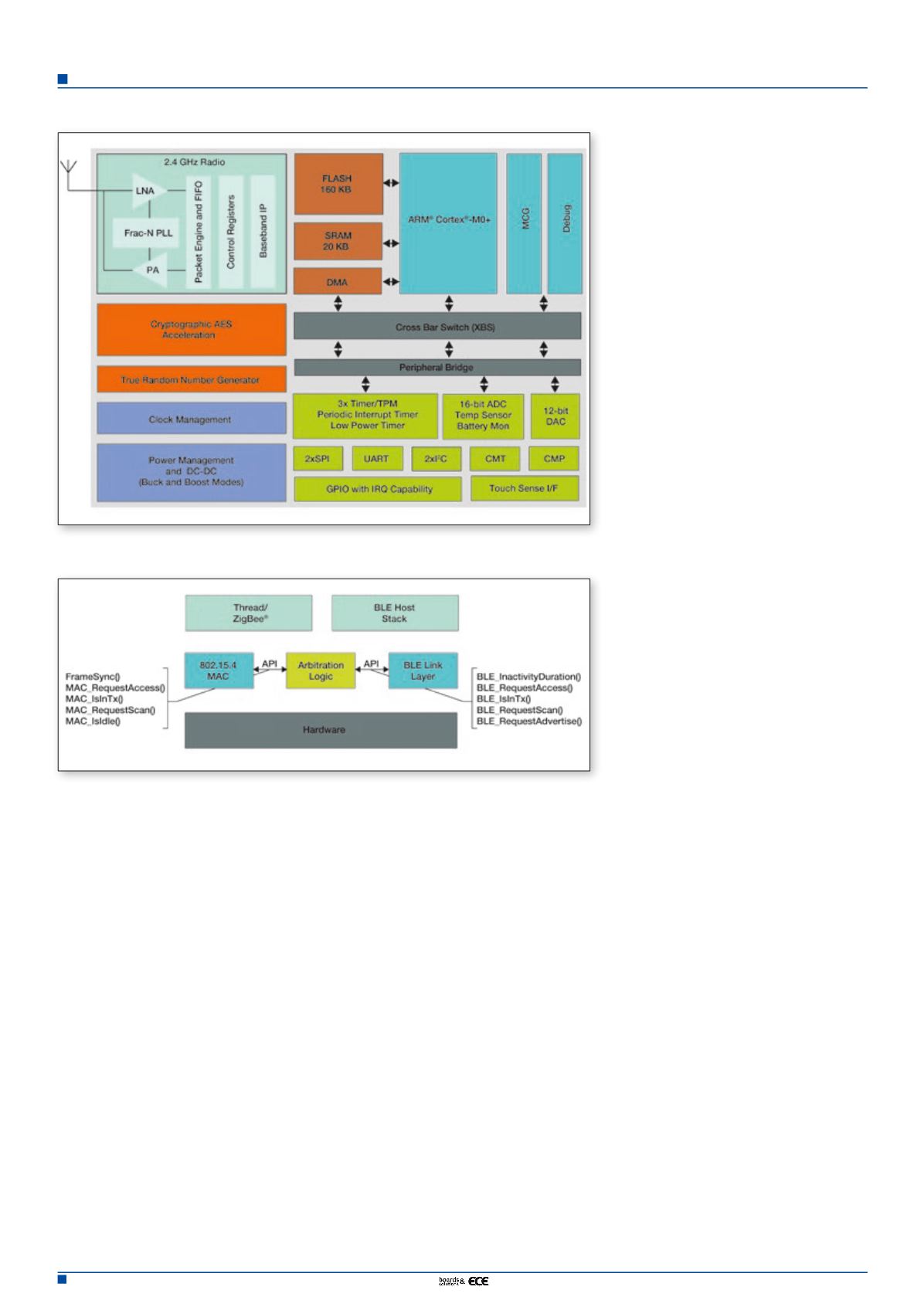
802.15.4. The Kinetis KW40Z system-on-chip
integrates a 2.4 GHz transceiver supporting
a range of FSK/GFSK and O-QPSK modu-
lations, 160 KB flash and 20 KB SRAM, BLE
link layer hardware, IEEE802.15.4 packet
processor, hardware security, and peripherals
optimized to meet the requirements of the tar-
get applications. These two protocols enable a
multitude of use cases for BLE profiles imple-
mentations coexisting with networking layers
on top of 802.15.4 (such as ZigBee or Thread).
Furthermore, they serve as an ideal building
block for implementing the gateway use case
(routing packets between a ZigBee or Thread
mesh and a Bluetooth Smart mesh network)
and the commissioning use case (using BLE
OOB data to commission a Thread/ZigBee
device).
The Kinetis KW40Z MCU offers multi-pro-
tocol support that follows the exact model of
link layer firmware arbitration as previously
proposed. The upper layers (BLE host stack
and Thread/ZigBee stacks) become agnostic
of the dual-mode nature of the system. The
arbitration firmware layer manages the two
link layer IP blocks for BLE and 802.15.4. This
management takes into account the specifics
of each protocol. The asymmetrical BLE pro-
tocol includes twomain states: pre-connection
(advertising/scanning) and connection (with
frequency hopping). Meanwhile, the 802.15.4
protocol simply transmits data point-to-point
with a robust flow control mechanism.
Freescale protocol arbitration firmware
implementation borrows from the MWS
coexistence logical signaling, described by the
Bluetooth specification. The concept of MWS
is embodied by 802.15.4, co-located on-chip
with BLE in the Freescale solution. Coex-
istence is managed via API function calls
grouped in service access points between the
software parts of the link layers for each proto-
col. These functions request access and inform
each data link layer of the other activity.
The particular natures of the two wireless pro-
tocols implemented by the Kinetis KW40Z
(especially the inherent low-duty cycle of
the BLE activity in the majority of profiles
and applications) allow for a default mode of
operation for the arbitration logic provided in
the firmware from the Kinetis KW40Z enable-
ment software packages. This essentially puts
the BLE link layer in a master mode to control
media access of the 802.15.4 MAC. In essence
- whenever the BLE needs to perform an oper-
ation, it preempts the 802.15.4 MAC for this
purpose; whenever it is in the process of per-
forming an operation (either advertising/
scanning or connection data transfer) it can-
not be preempted by the 802.15.4 MAC. Anal-
ysis has shown this to be very practical since
802.15.4 activity is minimally disrupted by
the low-duty cycle of BLE applications. This
default mode of operation requires a single
API function for signaling the 802.15.4 MAC
during idle periods in the BLE link layer. With
more intensive use of the BLE mode (such as
in the case of a Bluetooth Smart Mesh) the
full set of API functions would be required
to allow proper control of the protocol mul-
tiplexing.
The next generation of IoT-enabling Kinetis
microcontrollers - Kinetis KW41 MCUs - will
add even more value by allowing a physical
layer-only capability that expands the use case
landscape significantly (in addition to IEEE
802.15.4 and new BLE v4.2). This feature
provides a generic FSK modem that allows
configurable parameters for FSK modulation.
Together with software data link layer imple-
mentations, this enables compliance of the
whole system with several other established
protocols - which use various flavors of FSK
modulation. This also presents new chal-
lenges for protocol arbitration and multiplex-
ing approaches, requiring adaptation to two
hardware implementations of the 802.15.4
and BLE link layer plus one software imple-
mentation of another link layer which drives a
custom FSK PHY. The robustness of the arbi-
tration module implementation, coupled with
the specific multitasking capabilities brought
in by a real-time operating system, make the
dual-wireless protocol multiplexing solution
scale upwards to offer a multi-wireless proto-
col solution. It all begins with a configurable
set of rules, which the protocol arbitration
software module helps to configure and man-
age. And as data begins to flow in greater vol-
ume from our physical devices into the virtual
world, these and subsequent connectivity
innovations will be a major life force of the
IoT - allowing it to develop and grow on its
own terms.
n
Figure 3. Arbitration API calls
Figure 2. Kinetis KW40Z MCU block diagram


