October 2015
24
E
mbedded
C
omputing
New premium processor performance
for x86 low-power designs
By Gerhard Gilch,
congatec
The new Intel Pentium and Celeron
SoC processors (codenamed Braswell)
are impressive with their massive
plus in graphics and more balanced
overall performance. But why is this
high level performance necessary
on a 4-watt Scenario Design Power
and what makes these new top-class
low-power systems so special?
At present, the way we develop low-power
systems is changing rapidly. On the one hand,
parts of the distributed intelligence are drift-
ing off into the central cloud, resulting in
leaner on-site systems. On the other hand,
these systems require an industry-grade con-
nection to the Internet of Things (IoT). And
a very secure one at that. The corresponding
performance of the systems and the connec-
tion is a prequisite for this. Inevitably, the
demands placed on IoT-connected systems
will further increase, e.g. for interaction with
other systems in the field. The platform tech-
nology therefore needs to be extremely flex-
ibly scalable. In the majority of applications
graphics performance is essential, more and
more multiple high resolution screens are
being deployed, for example in kiosk and
retail systems, in slot machines and digital sig-
nage installations, in factories and in SCADA
systems or in countless HMIs in all sorts of
equipment, machinery and plants.
All these demands have to be catered for with
as few watts as possible in the low single digit
area to enable fanless, robust and space-saving
embedded designs. Today, we need a new, more
powerful performance class below the Intel
Core i processor line but also one that is more
balanced overall and widely scalable to allow the
development of entirely fitting, GUI-supporting
edge systems for the Internet of Things.
Previous x86 processor generations with com-
paratively few watts didn’t fit the bill in graph-
ics as well as general processing performance,
for example, in parallel virus scanning. Over
the past years, however, this gap has been
closing up progressively and with the avail-
ability of the new Intel processor generation
a new milestone has been set in the premium
class of low-power processors. The launch of
these processors also coincides with a mul-
titude of necessary design decisions in the
fast-moving environment of new IoT-driven
applications. Possibly this launch will affect
the embedded industry as significantly as the
launch of Intel Pentium M technology about
twelve years ago or the first Intel Atom pro-
cessor launch roughly seven years ago, which
sparked off the new SFF (small form factor)
trend of x86 processors. In this case however,
it will more likely be the market which will
dictate the course.
No matter whether the new Intel Pentium and
Celeron processor technology does spark off a
new era or not: it is one of the important build-
ing blocks for the IoT of intelligent embedded
devices and it’s worth looking at the techni-
cal details of the new processor even without
the IoT connection, since it offers an overall
improved performance with lower power con-
sumption and has become much more power-
ful in terms of graphics.
The new embedded Intel Pentium and Celeron
processors are all based on the new Airmont
microarchitecture, the 14nm variant of Intel
Silvermont microarchitecture, for which pro-
cessors were launched under the name of Pen-
tium, Celeron and Atom (all codenamed Bay
Trail). The Pentium name, however, has just
reappeared on the new Intel embedded road-
map with the new microarchitecture. With the
availability of the new microarchitecture, the
embedded processor range will therefore be
extended in the premiumclass of the low-power
segment. This underlines the special milestone
in the performance per watt advancement in
low-power processor technology.
The subcategories of the microarchitectures
in the Pentium, Celeron and Atom perfor-
mance ranges – and some further differen-
tiation characteristics like ECC support and
extended temperature range for Bay Trail-
based Intel Atom processors – make perfect
sense by the way. For customer applications,
the performance and power consumption of
a processor series are primary factors. Just
by naming the processor series, OEMs are
thus in a position to classify their customers’
expectations on board performance. Develop-
ers, on the other hand, profit from a uniform
microarchitecture by a simplified code devel-
opment for their applications. They only need
to optimize their code for a single architec-
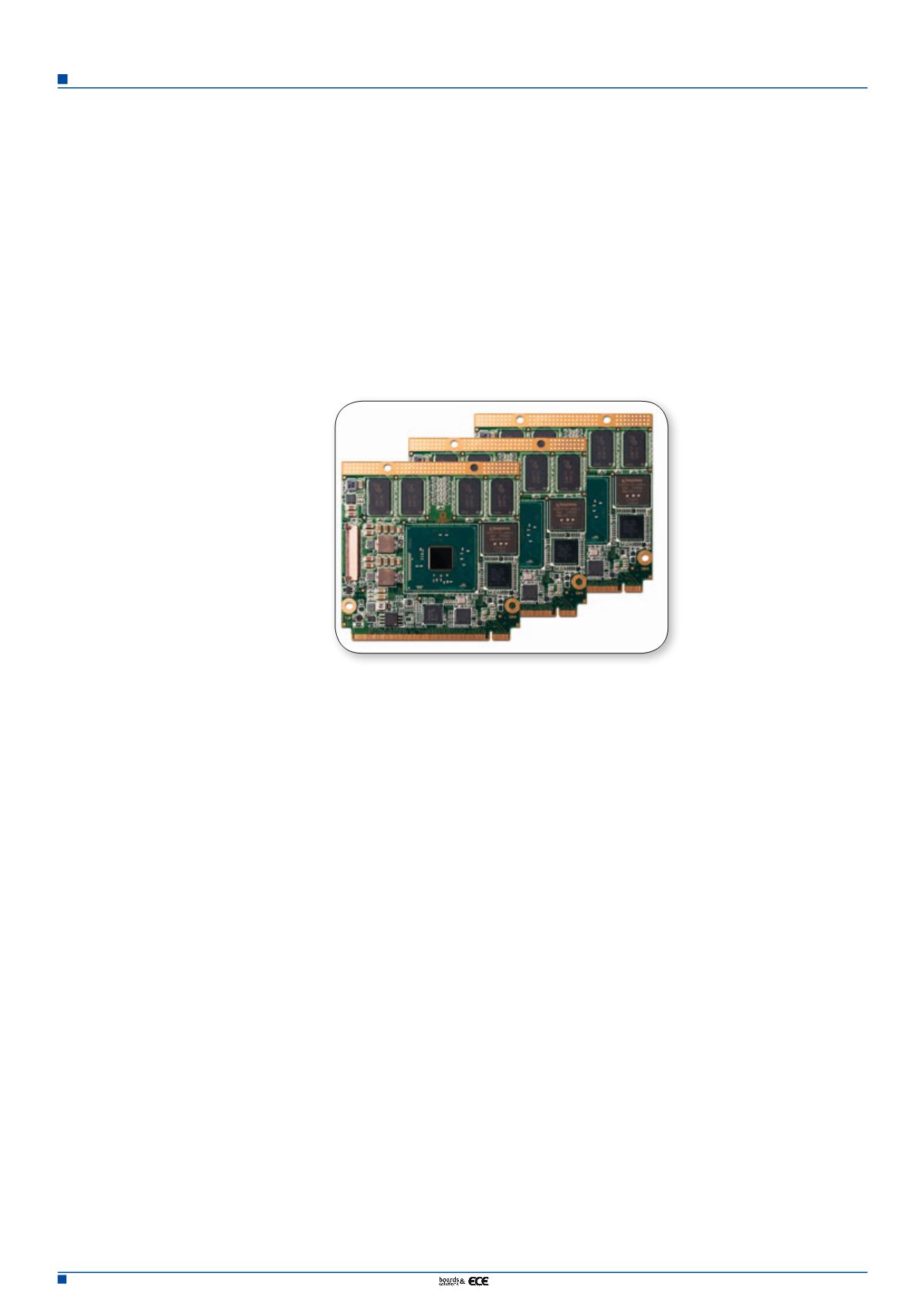
Figure 1. The conga-QA4 modu-
le is offered with three different
processor variants to provide
good scalability.


