October 2015
20
E
mbedded
C
omputing
Robust IoT – safety begins
with hardware
By Angela Bieber,
MEN
While the project described
in this article called for a very specific
housing to suit the customer needs,
many mobile IoT applications can
already be achieved using standard
systems. Networking of
the embedded world is thus
within reach – even if the
environmental conditions
become somewhat harder.
Despite the best efforts of internet giant
Google, the goal of predicting a flu epidemic
has yet to be achieved – but we have reached
the point where the Internet of Things in con-
junction with Big Data is now unstoppable.
Forecasts indicate that there will be more than
30 billion networked devices in the world by
the year 2020. This means we will also be see-
ing a huge increase in the number of IoT-en-
abled embedded systems, especially under
the banner of Industry 4.0. Supported by
Fieldbus and Ethernet technologies or wire-
less communications, networked devices like
these ensure the “smart” use and interopera-
bility between different systems in industrial
automation, energy generation and medical
technology.
Reliable IoT systems for demanding mobile
applications such as train-to-land communi-
cation are, however, very different to the net-
work components used in industrial settings.
Secure data transmission and the networking
of individual components are not the only
factors at play here. Devices used in these
situations must be designed to cope with an
extended temperature range; they must also
be resistant to shock, vibration and dampness,
and ensure the connection remains stable and
reliable throughout the journey or flight, etc.
In addition to the ability to withstand extreme
environmental conditions, another issue that
plays a crucial role in mobile markets – and
indeed in all IoT applications – is data secu-
rity. While the main focus from a software
point of view is on securing the transmis-
sion of data and the cloud, the hardware used
must first provide the necessary conditions to
ensure secure communication and protection
against external attacks.
This is achieved by various means, includ-
ing the use of a TPM-enabled (Trust Plat-
form Management) chip, which facilitates
encrypted data storage and secure booting.
One of the advantages of encrypted data stor-
age, for example in entertainment applications
in trains and buses, is that it offers a reliable
way for exclusive film material to be played
solely on the operator screens. Secure booting
ensures that the system can only be booted
after its integrity has been checked and there
have been no changes to the flash. This pro-
tects the system against unauthorized access.
A password-protected BIOS offers additional
anti-tampering protection, as does the secu-
rity provided by whitelisting, i.e. blocking
unauthorized applications.
Along with the myriad of measures taken to
ensure secure and robust IoT hardware com-
ponents, there is yet another factor to be
taken into account during the development
stage: the use of flexible architectures based
on open hardware standards. After all, while
it is not yet clear where things are headed with
the present assortment of competing com-
munication standards, widely used hardware
standards will continue to support commu-
nication between individual systems in the
future. One prime example of a successful
IoT system that also functions reliably under
even the most adverse conditions is currently
in use on oil platforms. Installed directly on
the drilling sites, the server platform commu-
nicates with the operator data processing cen-
ter in real time from here via GSM, relaying
all the data relating to the position of the drill
head, resistance in the drilling mud, as well as
general function and error analyses.
An extreme installation like this calls for
maximum performance where the mechan-
ical specifications are concerned – indeed,
the powerful computer with 200W of waste
heat would be enough of a challenge for
any system. The solution therefore had to
be just as extreme as the demanding situa-
tion itself: to begin with, the CompactPCI
standard components were equipped with a
solid conduction-cooled aluminum frame.
The components, in turn, are encased in an
IP64-protected housing, also with thermally
conductive properties. This alone would be
enough to have the system fully up and run-
ning and protected against the rough sea. But
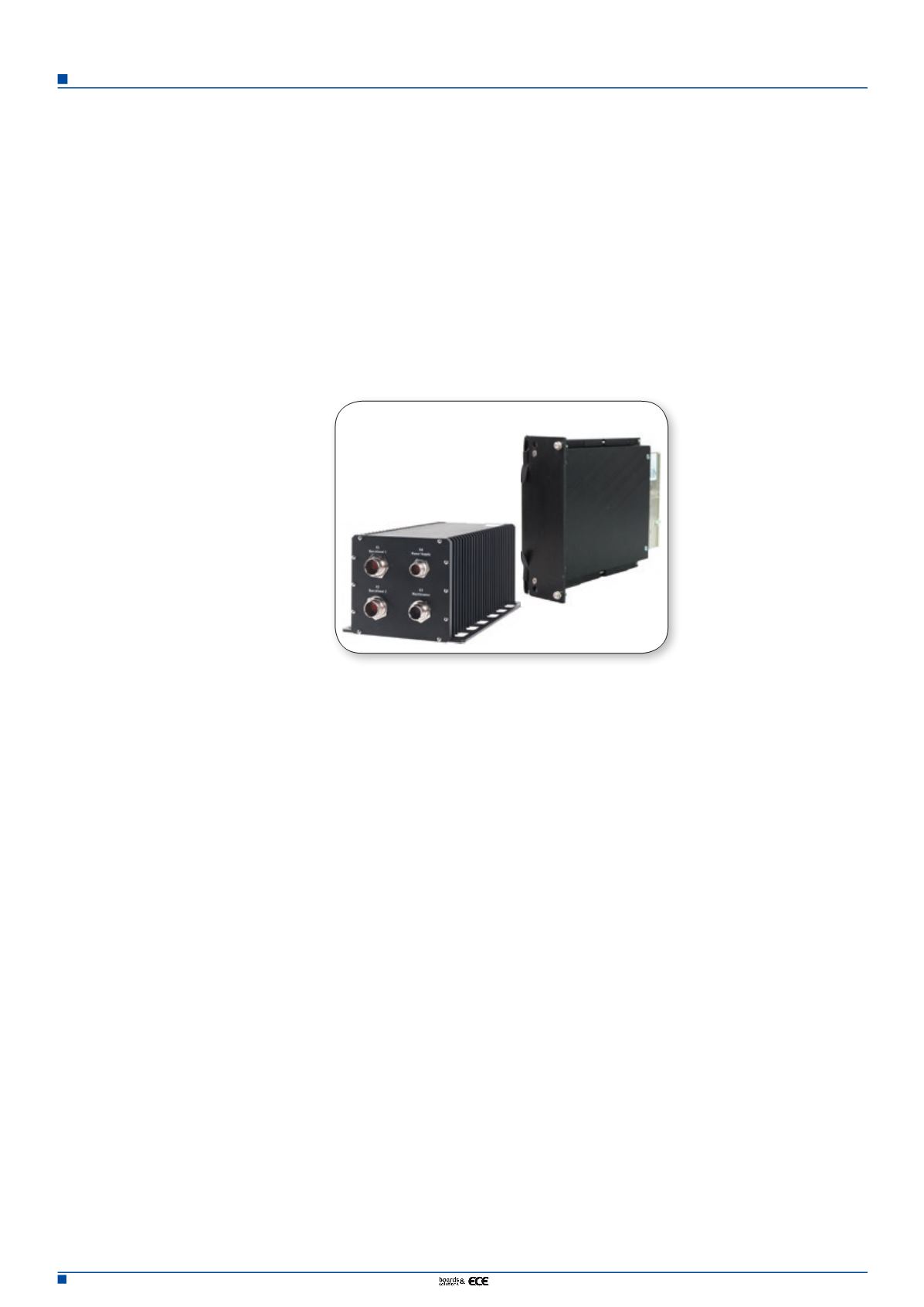
Figure 1. Heat management 4.0:
CompactPCI standard cards are
equipped with a solid conduc-
tion-cooled frame before being
mounted in conduction-cooled
housing. The image shows MEN
standard components.


