electronica Nov 2014
41
W
IRELESS
structure (e.g. a traffic light) cooperate to avoid
any potential collisions in the intersection. Other
vehicular safety use cases include such functions
as forward collision warning, blind spot warning,
etc. A model deployment of the collision-avoid-
ance system was launched in Ann Arbor, MI by
the US Department of Transportation in the fall of
2012 using a pool of 3000 cars. Based on the pos-
itive results of this trial, the Department of Trans-
portation announced in February 2014 that it is
working on regulations to require this technology
in light vehicles such as personal automobiles. In
the future, additional pieces of intelligent trans-
port systems could be enabled, such as connected
real-time traffic rerouting, dynamic lane manage-
ment, etc. Considering the recent research inter-
est in driverless cars, the potential of intelligent
transport systems and IEEE 802.11p appears even
more promising.
A final trend is the exploration of new unlicensed
spectrum. Today, WiFi devices utilize unlicensed
spectrum in the 2.4 and 5 GHz bands, which offer
bandwidths of approximately 100 and 500 MHz in
the US, respectively. However, many WiFi devices,
especially in the consumer market, use only the
2.4 GHz band due to cost and complex regulations
in the 5 GHz band. The latest WLAN standard,
IEEE 802.11ac, is limited to the 5 GHz unlicensed
spectrum to avoid the congestion at 2.4 GHz.
Although IEEE 802.11ac provides several per-
formance improvements, additional unlicensed
spectrum is required to truly take advantage of
the wider bandwidth modes and the correspond-
ing high data rates. Today, spectrum regulators
around the world are investigating ways to pro-
vide additional unlicensed spectrum in the 5 GHz
band. In the US, the Federal Communications
Commission (FCC) released a proposal in 2013 to
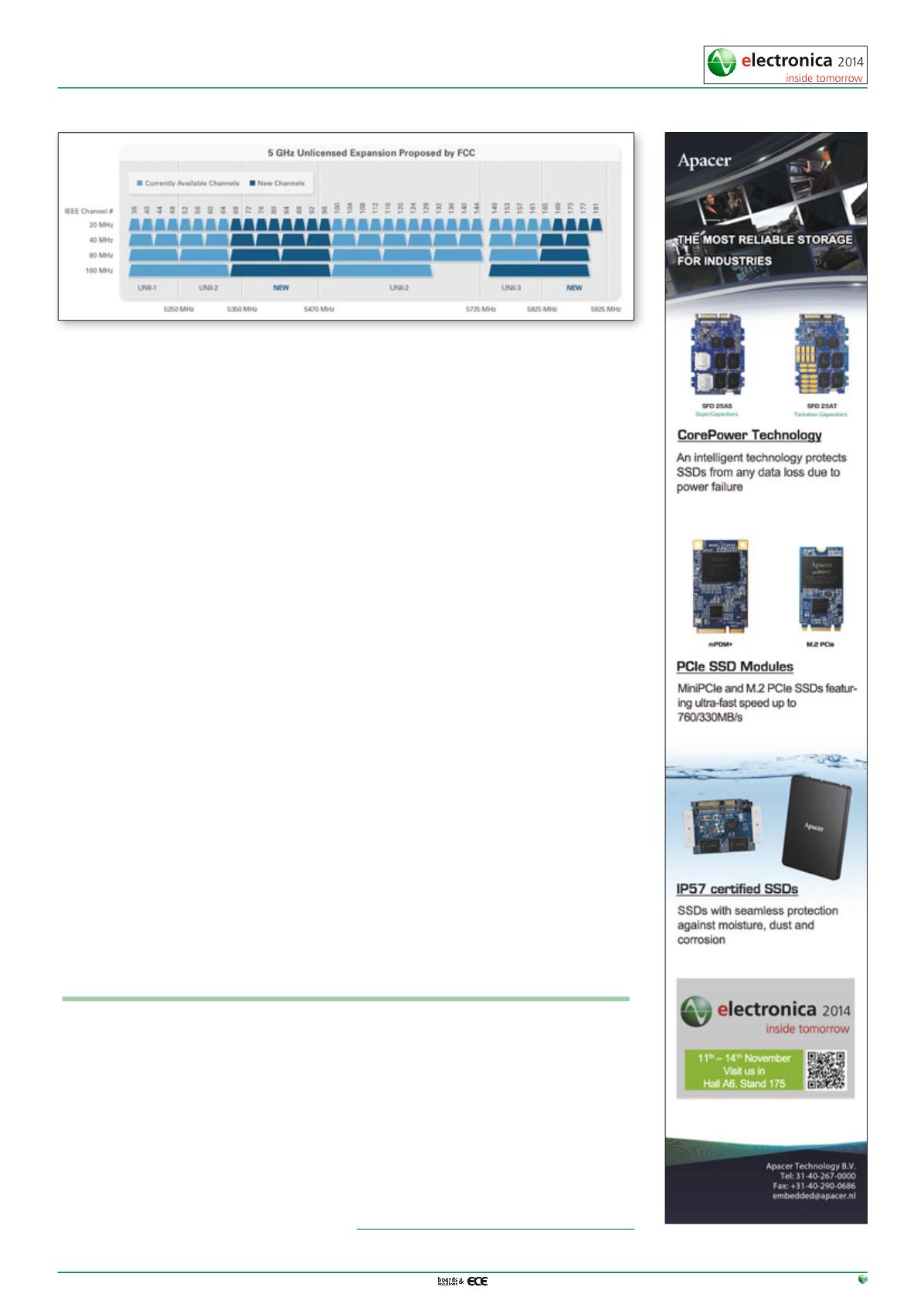
add almost 200 MHz to this band (figure 4) and
to simplify existing rules. Other regulators around
the world are also expected to move in a similar
direction. Several GHz of spectrum is available in
the 60 GHz millimeter waveband for unlicensed
use such as 57 to 64 GHz in the US and 57 to 66
GHz in the EU. Although using this spectrum for
consumer devices would have been unthinkable a
decade ago, advances in circuit technologies such
as introduction of relatively inexpensive millime-
ter wave CMOS manufacturing have changed that.
Due to the different nature of the 60 GHz band,
IEEE 802.11ad defined a unique PHY/MAC
stack for this band. For example, the significant
propagation loss at 60 GHz is mitigated by key
enabling technologies such as adaptive beam-
forming. In this case, antenna arrays create
highly directional beams that are rapidly adapted
to the changing channel between the communi-
cating devices. Target use cases for this technol-
ogy includes short-range communications such
as high-speed wireless cable replacement (e.g.
wireless HDMI, wireless docking) and wireless
interactive displays. The market rollout of this
technology is expected to accelerate in 2015.
Although WiFi technology and equipment have
been available for more than a decade, the inno-
vation in this market space is only accelerating.
Figure 4. The FCC released a proposal in 2013 to add almost 200 MHz to the available
bandwidth for use in the 5-GHz band.
ARM unveils a new 32-bit Cortex-M
processor achieving 5 CoreMark/MHz
ARM has unveiled a new 32-bit Cortex-M pro-
cessor that delivers double the compute and DSP
capability of today’s most powerful ARM-based
MCUs. The ARM Cortex-M7 is targeted at high-
end embedded applications used in next genera-
tion vehicles, connected devices, and smart homes
and factories. Early licensees of the Cortex-M7
processor include Atmel, Freescale and ST Micro-
electronics. The Cortex-M7 achieves an impres-
sive 5 CoreMark/MHz. This performance allows
the Cortex-M7 to deliver a combination of high
performance and digital signal control functional-
ity that will enable MCU silicon manufacturers to
target highly demanding embedded applications
while keeping development costs low. Expected
uses of Cortex-M7 include smart control systems
employed in a range of applications such as motor
control, industrial automation, advanced audio,
image processing, a variety of connected vehicle
applications and other Internet of Things (IoT)
uses.
Product News


