electronica Nov 2014
32
M
ICROCONTROLLERS
complementary pairing, half-cycle reload and
up to 4 fault inputs for global fault detection.
Half-cycle reload increases control algorithm
efficiency by pre-loading values prior to next
edge of PWM, requiring fewer tasks to be
performed on a PWM transition. Managing
the FTM–ADC relationship is the program-
mable delay block that delays triggering from
the FTMs to the ADCs and helps to define
conversion sample points for precise rotor
position detection in sensorless applications.
Additional analog peripherals include dual
comparators that detect motor over-current/
voltage fault conditions triggering PWM safe
state shutdown, and a 12-bit DAC for config-
uring fault levels in software. With many low-
end designs subject to strict price pressures
(particularly consumer products), these fea-
tures help minimize BOM costs through the
elimination of external circuitry.
Kinetis KV1x MCUs offer 16 or 32 KB of flash
memory with IIC, SPI and UART communi-
cation interfaces. A cyclic redundancy check
(CRC) module can be used in conjunction
with the DMA to satisfy IEC 60730 hardware
safety requirements such as periodic calcu-
lation of the CRC checksum in flash mem-
ory. For low-power applications, multiple
low-power modes, watt-saving architectural
techniques and autonomous, power-smart
peripherals can also be leveraged. With this
level of feature integration (not to mention
the free enablement support), it is reason-
able to expect the KV1x family to be priced
beyond the reach of most entry-level design
budgets where cost dominates performance
and peripheral selection.
This is not the case as intelligent use of 90nm
technology sets the KV16 MCU in a 32LQFP
package at a starting price of $0.99 (USD,
10,000-unit quantities), with additional
48LQFP and small footprint 5mm x 5mm
32QFN packages priced accordingly. Situated
further up the Kinetis V series is the KV3x
family that addresses mid-range BLDC and
PMSM motor designs and features the ARM
Cortex-M4 core with DSP instruction support
and a floating point unit. Core frequencies
range from 100-120 MHz and flash memory
from 64-512 KB with an optional external bus
interface for off-chip system expansion. A fac-
tory-installed, flash based bootloader enables
quick and easy programming of the MCU
during development, final product manufac-
turing or in the field.
The flagship of the Kinetis V series is the
KV4x family which targets advanced PMSM
and ACIM designs that require high dynamic
control. Engineered for optimal performance,
it also incorporates the ARM Cortex-M4 core
but at an increased frequency of 150 MHz.
Code is executed from up to 256 KB of flash
memory via a 128-bit wide interface which
helps minimize CPU wait states. With up to
30 timer channels – 12 provided by the highly
flexible Enhanced FlexPWM (eFlexPWM)
module – the KV4x family has no trouble
supporting multiple three-phase motors con-
currently. Motor speed/position detection
comes from two cyclic 12-bit ADCs with sam-
ple rates of 1.9 or 4.1 Msps depending on the
device selected. These can be triggered by any
module connected to the internal peripheral
crossbar of the MCU, including timers, analog
comparators or GPIO.
The KV4x family’s high degree of feature inte-
gration enables up to 30 PWM outputs, 38
ADC channel inputs, as well as CAN, UART
and SPI interfaces to be housed in a 100-pin
LQFP package. All Kinetis V series MCUs
operate from 1.71 to 3.6V and from -40C to
105C. Production-qualified Kinetis KV1x and
KV3x MCUs are available now; KV4x MCUs
are currently sampling and are planned to
enter production early in Q1 2015.
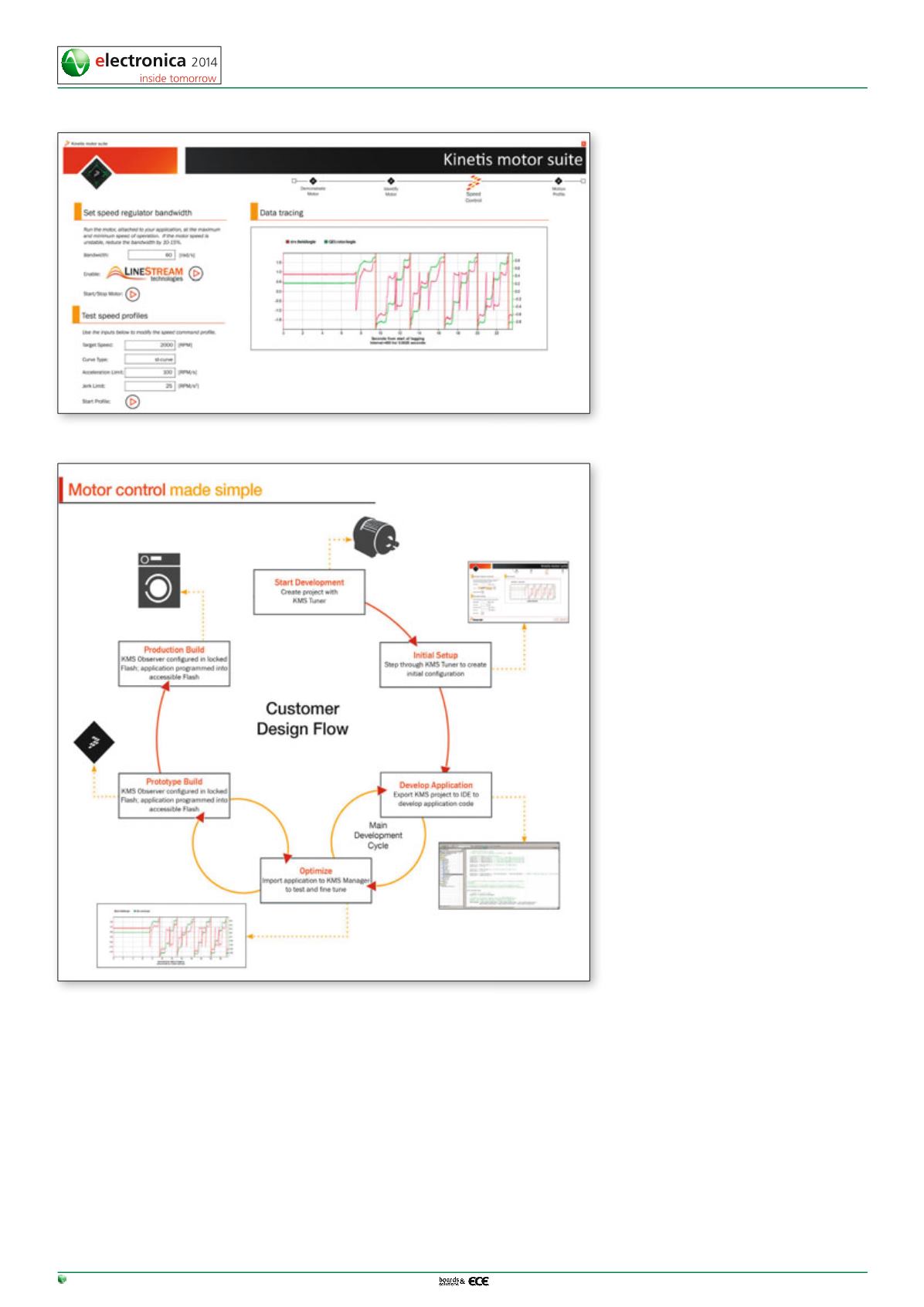
Kinetis Motor Tuner GUI
Kinetis Motor Suite design flow


