electronica Nov 2014
39
W
IRELESS
experience a WiFi network crash at a trade-
show or other where the presence of a large
number of WiFi devices leads to high inter-
ference. This is because, traditionally, IEEE
802.11 standards have focused on point-
to-point link data rate improvements in an
indoor network consisting of a single access
point and a few clients working under light
external interference. This objective needs to
be amended to consider total system through-
put and fairness, given the market reality of
denser indoor and outdoor deployments. To
address this, the IEEE formed a new IEEE
802.11 study group (SG) called High-Effi-
ciencyWLAN (HEW) in July 2013. The efforts
of this study group are expected to lead to the
next major evolution of the IEEE 802.11 stan-
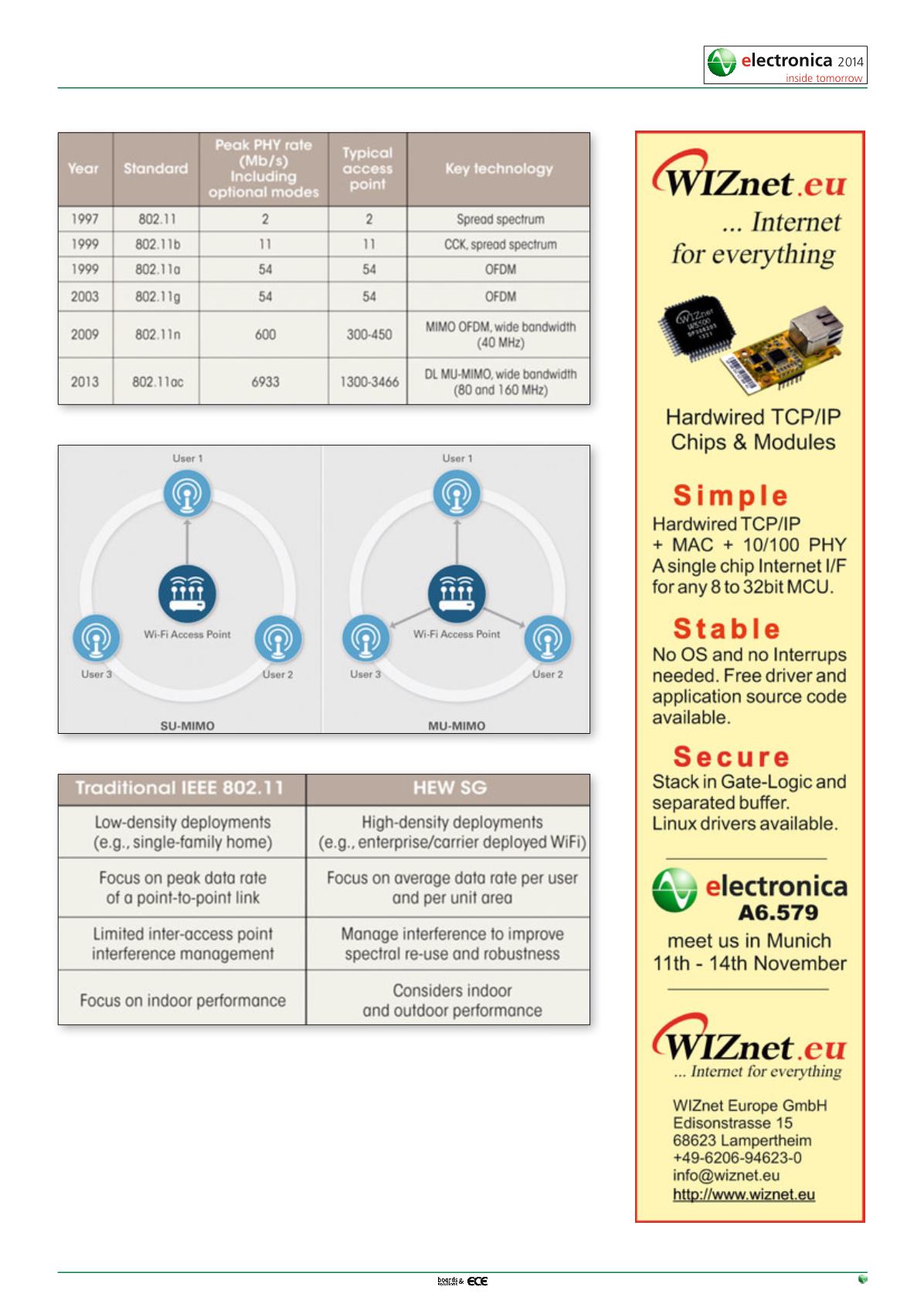
dard after IEEE 802.11ac. Table 2 compares
Table 1. WLAN physical layer evolution.
Figure 1. A MU-MIMO can better utilize the MIMO capabilities of a WiFi network.
Table 2. Traditional IEE 802.11 versus HEW SG goals.


