electronica Nov 2014
34
Low-power MCU design techniques
for battery-powered devices
By Graeme Clark,
Renesas
This article highlights the advantages
of using the low-power capabilities
of 32-bit microcontrollers such as
the RenesasRX100, and shows how
system engineers can apply them to
design battery-powered products
within extremely tight power
dissipation limits. It also shows how
such devices can be used in real low
power applications with improved
system performance and reduced
total system cost.
In today’s competitive market place, design-
ers are being asked to provide ever more
function for less: less cost, less power, less
size. This is especially true with the mar-
ket drive towards more energy-efficient and
green products. Next generation microcon-
trollers, like Renesas RX100, are designed to
save energy, delivering strong levels of CPU
performance with advanced peripheral and
memory integration, while consuming next
to no power during operation. These innova-
tive devices can wake up quickly from sleep
mode, consume far less current when running
than existing solutions, and achieve outstand-
ing overall levels of performance. These are
advantages that system engineers can use to
create products offering a wide range of new
capabilities to meet the needs of the market
today and tomorrow.
The RX100 microcontrollers are the first
32-bit MCUs in the industry to combine
breakthrough power-control technology with
innovative features such as fast wake-up times,
zero-wait-state flash, multiple safety func-
tions, integrated USB 2.0 host/device and
on-the-go support, all at a very competitive
price point. These microcontrollers are the
best choices for low-end 32-bit applications
like mobile healthcare devices, smart meters,
and security systems, as well as sensors, detec-
tors and other elements of industrial control
systems and building automation equipment.
The major low-power characteristics of these
devices include: exceptional RUN-mode
power efficiency; 100μA/MHz; ultra-fast
wake-up time, 4.8μs or less; superior architec-
ture; 3.08 Coremarks/MHz performance; six
operating modes, plus numerous other design
options for saving power, and standard and
advanced on-chip peripherals, ADC, LVD,
RTC, USB, and more.
Multiple power-optimised run modes (high
speed, middle speed, and low speed) mini-
mise power consumption when different CPU
speeds are needed for various application
tasks. Additionally, three low-power modes
(sleep, deep sleep and software standby), in
combination with the short wake-up times
from these modes, let system engineers fine-
tune both system performance and the power
supply to meet specific application require-
ments. There are many other power-saving
techniques that should be noted: the use of
zero-wait-state flash memory technology
decreases power consumption because the
CPU doesn’t have to remain idle while wait-
ing for data fetched from non-volatile storage.
Every on-chip peripheral module can be pow-
ered off individually, so that those not being
used don’t waste power. An advanced clock
system allows the speed of the clocks driving
the peripherals to be reduced while the CPU
operates at up to its maximum frequency.
Moreover, a choice of oscillators (HOCO or
LOCO) for waking up the CPU, and extra
power reductions can be obtained in some sit-
uations by utilising those clocks to replace the
phase-lock loop (PLL) main clock.
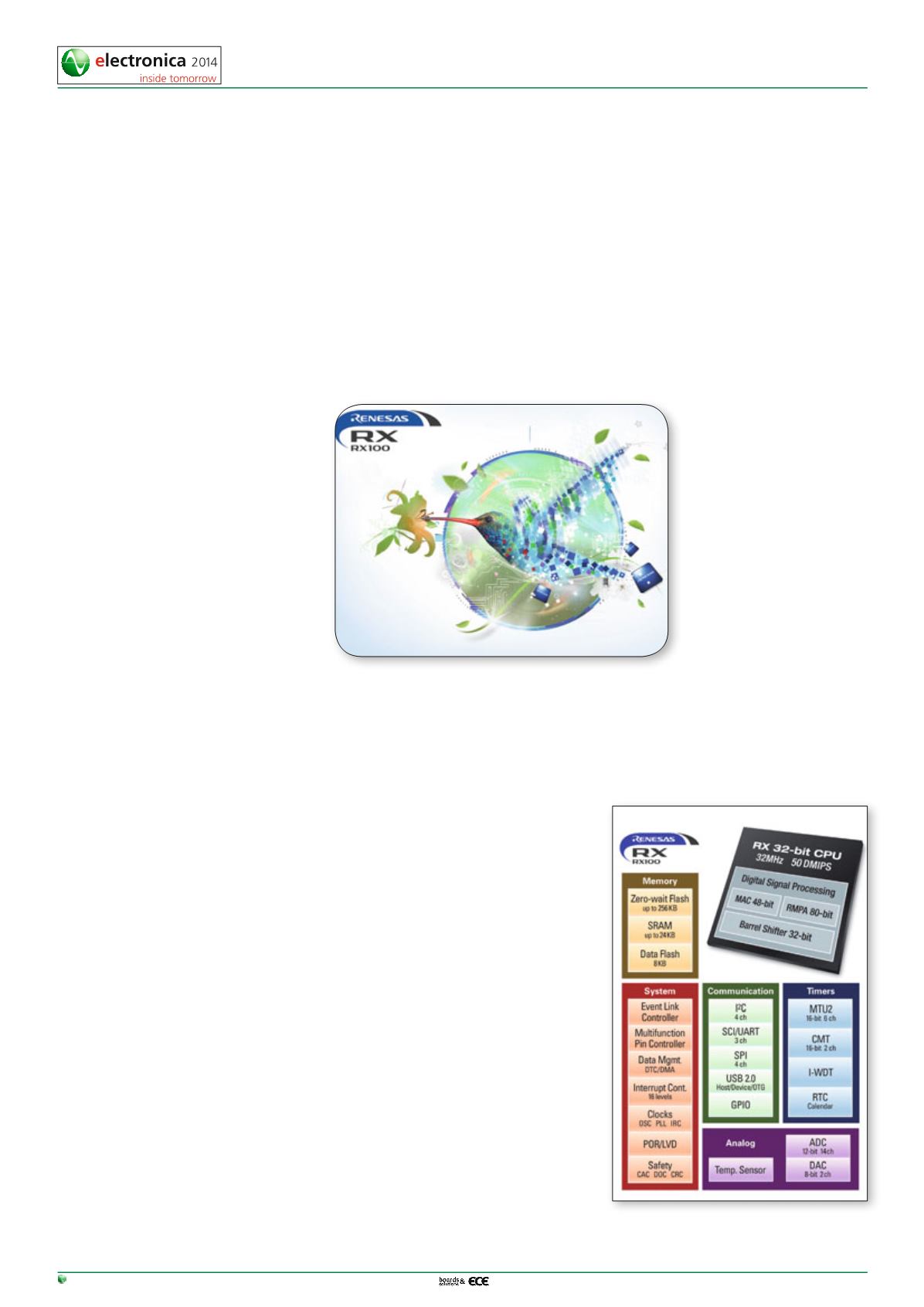
Figure 1. RX111 block diagram
M
ICROCONTROLLERS


